- Who files
- IFTA licensees based in Tennessee
- Due
- April 30, July 31, October 31, January 31
- Filed with
- Tennessee DOR (TNTAP or mail)
- Form revision
- RV-R00108 (08/26)
- Credits
- Use within eight quarters
At a glance
Tennessee's IFTA return is the International Fuel Tax Agreement Tax Return, IFT 506 (form RV-R00108, revised 08/26): two pages of summary and a landscape Fuel Tax Computation Worksheet. This page follows that form and the Department of Revenue's instructions for it. It is general information, not tax advice.
- Online or paper. “All Motor Carrier registrations and transactions can be completed using our Tennessee Taxpayer Access Point, TNTAP.” A paper return goes to Tennessee Department of Revenue, Vehicle Service Division, 500 Deaderick Street, Nashville, TN 37242, with the amount due on Part 3, line 6 (printed on the form).
- Due. “The tax return and full payment of taxes is due on the last day of the month that follows the close of the tax reporting period.” See IFTA due dates.
- Order of work. Part 1 (miles per gallon), then the worksheet, then Part 2 (the worksheet totals), then Part 3 (what you owe).
- Tennessee specifics. License, decals and contacts are on the Tennessee IFTA page.
Tap a box once for its note, again to jump to the line. Zoom in to read the small print.
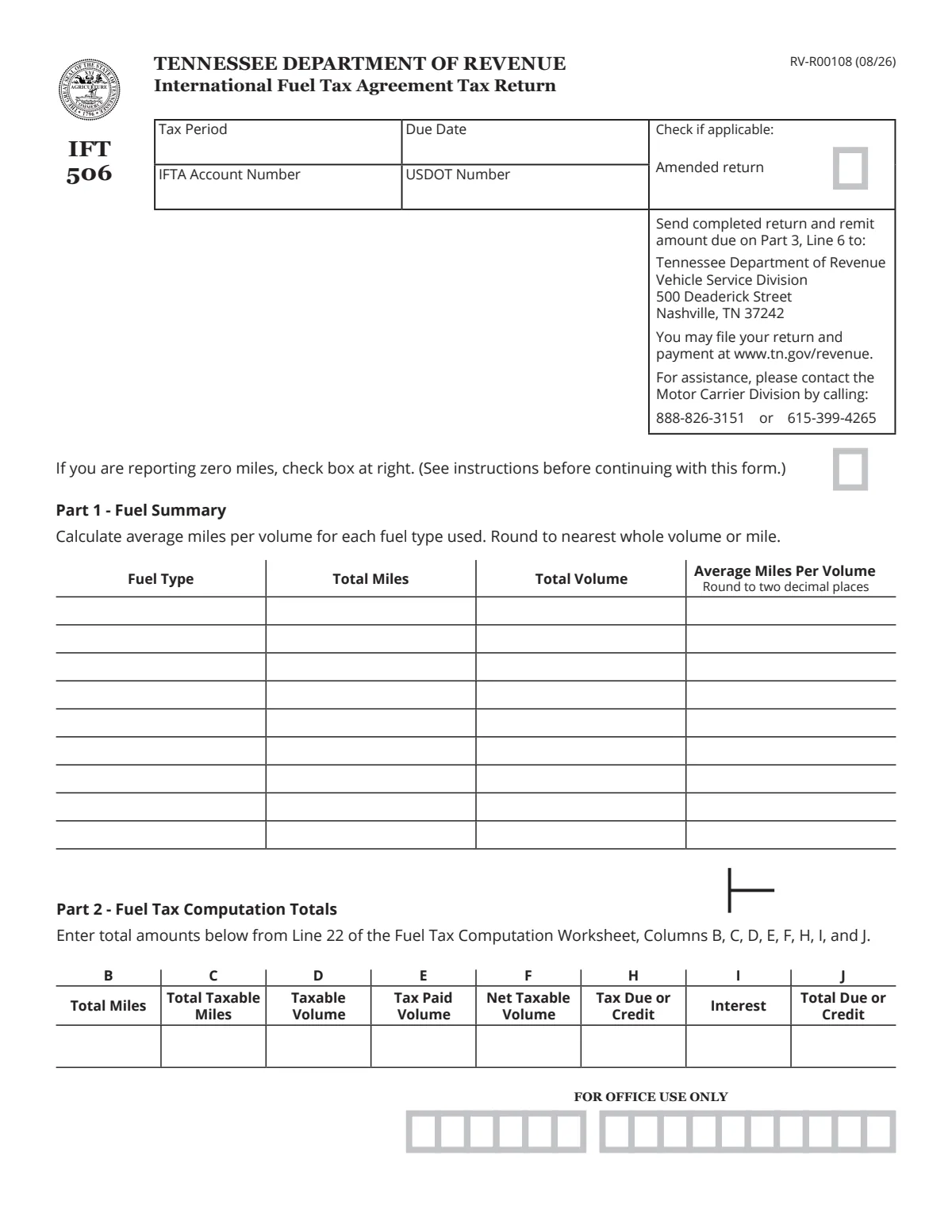
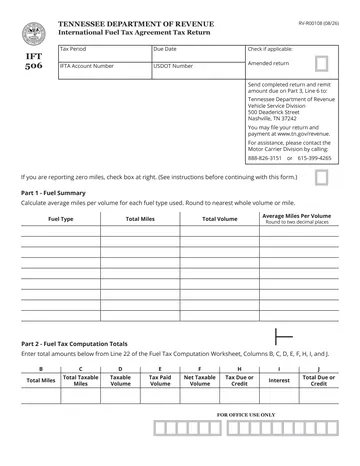
Page 1: header, Part 1 and Part 2
Part 1 sets one miles-per-gallon figure for each fuel. Part 2 is filled in last, from line 22 of the worksheet.
| Box | Label | What goes there |
|---|---|---|
| Period | Tax Period, Due Date | “Quarterly reporting due dates are April 30, July 31, October 31, and January 31.” A Saturday, Sunday or legal holiday moves the date to the next business day. |
| Account | IFTA Account Number, USDOT Number | Your Tennessee IFTA account number and USDOT number (P720.100). |
| Amended | Check if applicable: Amended return | “Check the box to indicate that this return reflects changes to the previously filed return for this” quarter. |
| Zero | If you are reporting zero miles, check box at right | “Check this box only if you are reporting zero miles for this quarter.” Sign and date page 2 and send the return; see zero returns. |
| P1-Fuel | Part 1: Fuel Type | “List all fuel types used this quarter.” |
| P1-Miles | Part 1: Total Miles | “Enter total miles traveled in all IFTA and non-IFTA jurisdictions for each fuel type you are reporting.” “Total miles entered in this column should match Column B on the Fuel Tax Computation Worksheet.” |
| P1-Volume | Part 1: Total Volume | “Enter total gallons put into vehicle(s) in all IFTA and non-IFTA jurisdictions for each fuel type.” It should match worksheet Column E. |
| P1-MPG | Part 1: Average Miles Per Volume | Total miles divided by total gallons. “MPG must be rounded to two decimal places. Example: 5.127 should be rounded to 5.12.” (The example drops the third decimal rather than rounding it up; the agreement asks only for two decimal places, P720.350.) |
| P2-B | Part 2: Column B, Total Miles | After the worksheet is done, “carry the total amounts from Line 22, Columns B through F” and Columns H to J to Part 2. |
| P2-C | Part 2: Column C, Total Taxable Miles | Worksheet line 22, Column C. |
| P2-D | Part 2: Column D, Taxable Volume | Worksheet line 22, Column D (without surcharge gallons). |
| P2-E | Part 2: Column E, Tax Paid Volume | Worksheet line 22, Column E. |
| P2-F | Part 2: Column F, Net Taxable Volume | Worksheet line 22, Column F. |
| P2-H | Part 2: Column H, Tax Due or Credit | Worksheet line 22, Column H. It goes to Part 3, line 1. |
| P2-I | Part 2: Column I, Interest | Worksheet line 22, Column I. It goes to Part 3, line 3. |
| P2-J | Part 2: Column J, Total Due or Credit | Worksheet line 22, Column J. |
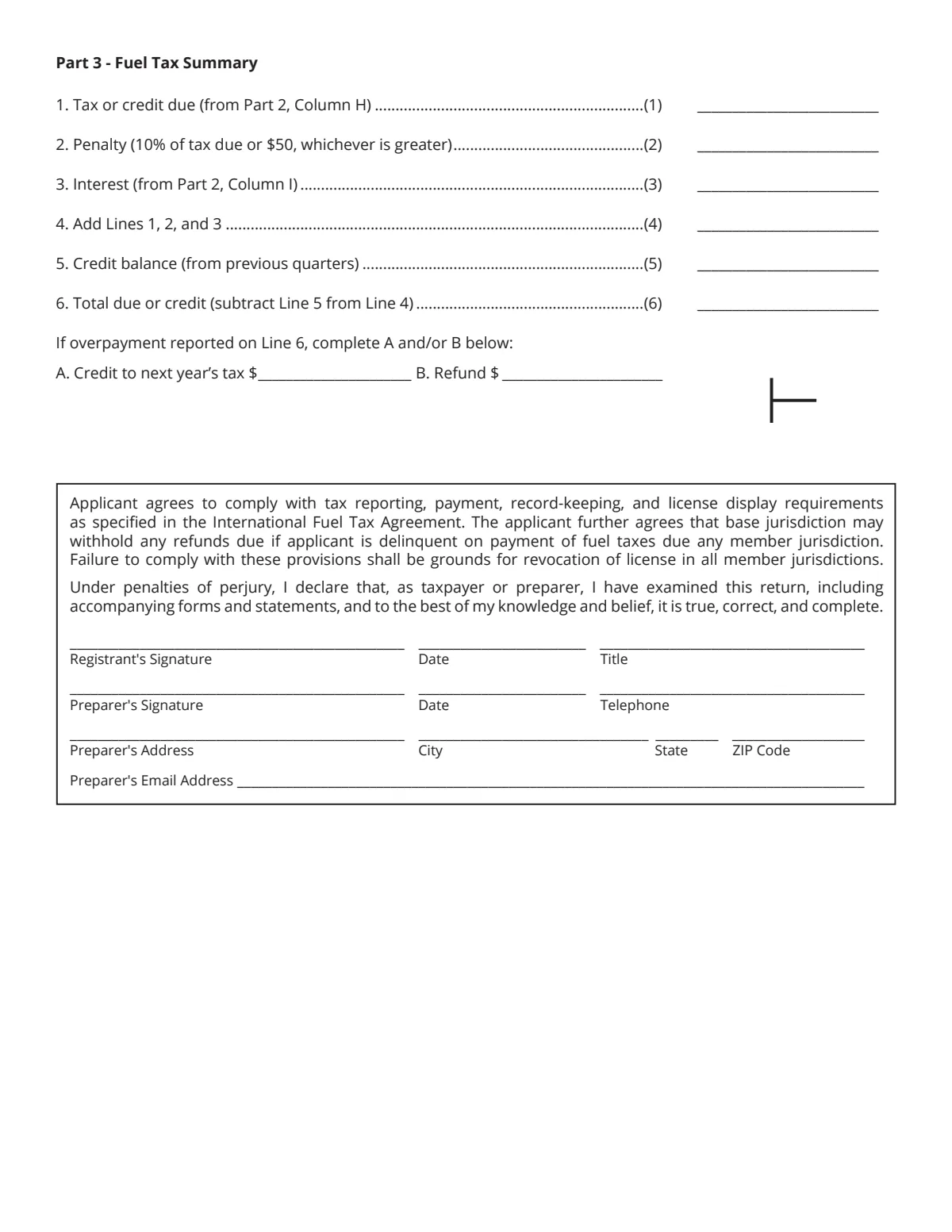
Page 2: Part 3, Fuel Tax Summary, and signatures
| Line | Label | What goes there |
|---|---|---|
| 1 | 1. Tax or credit due (from Part 2, Column H) | “Enter amount calculated on Part 2, Column H. This is the amount of tax or credit due.” |
| 2 | 2. Penalty | “Penalty due for delinquent returns is calculated at 10% of tax due or $50, whichever is greater.” That is the P720.600 standard. |
| 3 | 3. Interest (from Part 2, Column I) | Interest is due for each jurisdiction on tax paid after the due date: the Part 2, Column I total. |
| 4 | 4. Add Lines 1, 2, and 3 | The sum of lines 1 to 3. |
| 5 | 5. Credit balance (from previous quarters) | Any credit available from an earlier quarter. “Credit balances must be used within eight quarters.” |
| 6 | 6. Total due or credit (subtract Line 5 from Line 4) | Pay this amount with the return. For a credit: “If the amount indicates a credit balance equal to or greater than $10,” “you may request a refund.” |
| AB | A. Credit to next year's tax, B. Refund | For an overpayment on line 6, fill in A to carry the credit forward or B to request a refund (at least $10). |
| Sign | Registrant's signature, date, title | The applicant agrees to IFTA's reporting, payment, record-keeping and license display rules and declares the return true under penalties of perjury. “The owner, partner, or corporate officer must sign and date the return.” Another signer needs a power of attorney on file. |
| Preparer | Preparer's signature, date, phone, address, e-mail | “Any person who is paid for preparing a licensee’s tax return must also sign the return as a preparer.” |
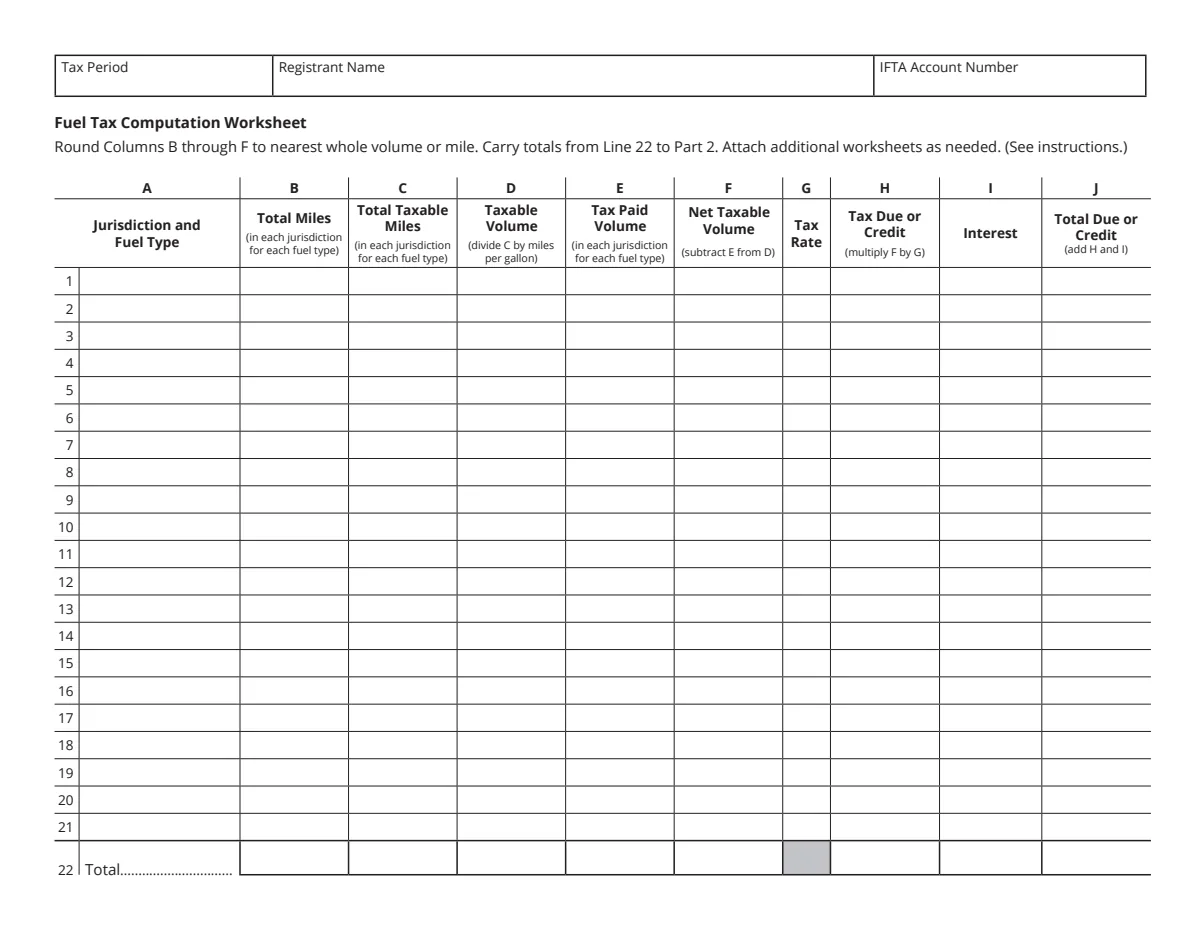
The fuel tax computation worksheet
“Round Columns B through F to nearest whole volume or mile.” One line per jurisdiction and fuel, plus a Surcharge line below Indiana, Kentucky and Virginia.
| Column | Label | What goes there |
|---|---|---|
| W-Head | Tax Period, Registrant Name, IFTA Account Number | On every worksheet page. “Attach additional worksheets as needed.” |
| A | A. Jurisdiction and Fuel Type | “List each jurisdiction traveled and the type of fuel consumed during the reporting period.” “Jurisdictions with a surcharge enter the word Surcharge on the line immediately below each” jurisdiction with a surcharge, for each fuel used. |
| B | B. Total Miles (in each jurisdiction for each fuel type) | Total miles in each jurisdiction for each fuel, rounded to the whole mile. 0 on a surcharge line. |
| C | C. Total Taxable Miles | Taxable miles in each jurisdiction for each fuel. 0 on a surcharge line. “All Tennessee miles are taxable.” Other jurisdictions' exemptions are listed at iftach.org; see taxable miles. |
| D | D. Taxable Volume (divide C by miles per gallon) | Column C divided by the Part 1 average for that fuel. A surcharge line repeats the same taxable gallons, but “Do not include surcharge gallons in the Column D total on Line 22.” |
| E | E. Tax Paid Volume | “Enter the gallons purchased in each jurisdiction for the reporting period on which fuel taxes have been paid.” 0 on a surcharge line. Keep the receipts; see fuel receipts. |
| F | F. Net Taxable Volume (subtract E from D) | Column D minus Column E; “if E is greater than D enter the credit figure in brackets.” Example from the instructions: <50>. |
| G | G. Tax Rate | The rate for each fuel in each jurisdiction. For a surcharge jurisdiction, “enter the surcharge tax rate for each fuel type on the surcharge line.” |
| H | H. Tax Due or Credit (multiply F by G) | Column F times Column G in dollars and cents; credits in brackets. “Note: Surcharges are never a credit.” |
| I | I. Interest | Interest on tax paid after the due date: “Multiply Column H by the monthly rate of 0.005” (the instructions' figure). The agreement sets the interest rate each year for U.S.-based fleets (R1230.100): two points above the IRS underpayment rate, and “Interest shall accrue monthly at 1/12 this annual rate.” A monthly rate printed on a form can be older than the current one; check it against the penalties and interest guide or the penalty and interest estimator. |
| J | J. Total Due or Credit (add H and I) | Carried to three decimals, then rounded to two. “Example: $82.565 rounded to $82.57.” Credits in brackets. |
| 22 | Line 22: Total | Totals of Columns B through J, carried to Part 2. With several worksheet pages, “the amount entered into Part 2 should reflect the grand total across all worksheets.” |
Worked line: Part 1 shows 6.00 miles per gallon for diesel. Kentucky Column C is 1,800 taxable miles, so Column D is 300 gallons; with 100 tax-paid gallons bought in Kentucky (Column E), Column F is 200. On the Surcharge line below, Column D repeats 300 and Columns B, C and E are 0; the surcharge is Column D times the surcharge rate. Run the numbers in the quarterly return calculator.
How the columns follow P720
Every member jurisdiction prints its own return, but the IFTA Procedures Manual sets what each one must hold. P720 says “Each jurisdiction shall provide, at a minimum, the following elements to be present on a standard tax return.” and P700 adds that the elements apply “regardless of the method of completion of the tax return”. The table matches the P720 list to the boxes on this form, so you can check a return line by line against the agreement.
| P720 | Element the agreement requires | Where it is on this form |
|---|---|---|
| P720.050 | Jurisdiction's name and mailing address | Page 1: Tennessee Department of Revenue, Vehicle Service Division, 500 Deaderick Street, Nashville |
| P720.100 and .150 | License number; licensee name and address | IFTA Account Number; Registrant Name on the worksheet |
| P720.200 | Tax reporting period | Tax Period, on page 1 and the worksheet |
| P720.250 to .400 | Total distance, total fuel, average factor, fuel type | Part 1, one line per fuel type |
| P720.500 .010 to .050 | Rate, total miles, taxable miles, taxable volume, tax-paid volume, net taxable volume, tax, interest, total | Worksheet Columns G, B, C, D, E, F, H, I, J |
| P720.550 | Column totals | Worksheet line 22, carried to Part 2 |
| P720.600 and .650 | Penalty; total remittance | Part 3, lines 2 and 6 (previous credits on line 5) |
| P720.700 to .850 | Date, signature, title, phone | Page 2 signature lines (the phone line is the preparer's) |
Rules that trip people up
- Surcharge lines: 0 in Columns B, C and E, the same Column D as the jurisdiction's own line, and never a credit. Their gallons stay out of the line 22 Column D total.
- Part 1 totals must match the worksheet: total miles with Column B, total gallons with Column E.
- Credits carried on line 5 expire after eight quarters; a refund needs a credit of at least $10.
- All Tennessee miles are taxable, so for Tennessee, Columns B and C match.
How it connects
- The method behind every column: how to file an IFTA quarterly return, step by step, and the quarterly return calculator, which runs the same P720 worksheet in your browser.
- Taxable and total miles: taxable miles vs total miles.
- Tax-paid gallons and receipts: tax-paid fuel credits and what a fuel receipt must show.
- Surcharge lines: IFTA surcharge jurisdictions.
- Dates, late filing and corrections: IFTA due dates, penalties and interest, zero returns and amended returns and refunds.
- Rates: the fuel tax rate lookup, built from the jurisdictions' own rate notices.
- Tennessee license, decals and contacts: the Tennessee IFTA guide.
Questions filers ask
Can I file the Tennessee IFTA return online?
Yes. Tennessee says all motor carrier transactions can be completed in TNTAP, and the paper form notes you may file your return and payment at tn.gov/revenue.
How long can I carry an IFTA credit in Tennessee?
The instructions say credit balances must be used within eight quarters. A credit of $10 or more on line 6 can be refunded instead.
What do I put on the Kentucky surcharge line?
The word Surcharge in Column A on the line below Kentucky, 0 in Columns B, C and E, the same taxable gallons in Column D, the surcharge rate in Column G, and the tax in Column H.
Who must sign the Tennessee return?
The owner, partner or corporate officer. Anyone else needs a power of attorney on file, and a paid preparer signs as preparer too.