- Who claims
- The ultimate purchaser of the fuel
- Filed with
- The income tax return (Form 1040, 1120, 1120-S, 1041)
- Carrier lines
- Part I, 1a, 3a, 17
- Rates (2025 form)
- Gasoline $.183; undyed diesel $.243 a gallon
- Records
- At least 3 years
At a glance
Form 4136, Credit for Federal Tax Paid on Fuels, gives an income tax credit for federal fuel tax paid on fuel used for a nontaxable purpose. For a motor carrier that mostly means undyed diesel burned in a reefer unit with its own motor, and fuel used in off-highway equipment. This page covers the 2025 form (filed with 2025 income tax returns) and only the lines a motor carrier uses: the header, Part I, lines 1a and 3a with their credit columns, and line 17. The other lines are listed, not explained. It is general information, not tax advice.
- Who claims. The ultimate purchaser of the fuel, on its income tax return.
- Not for the truck's own fuel. Fuel that propels a registered highway vehicle is taxable use, even when the engine also runs equipment through a power take-off.
- Records. “You must keep records to support any credits claimed on this return for at least 3 years from the date the return is due or filed, whichever is later.”
- Income. “Include any credit or refund of excise taxes on fuels in your gross income if you claimed the total cost of the fuel (including the excise taxes) as an expense deduction that reduced your income tax liability.”
Tap a box once for its note, again to jump to the line. Zoom in to read the small print.
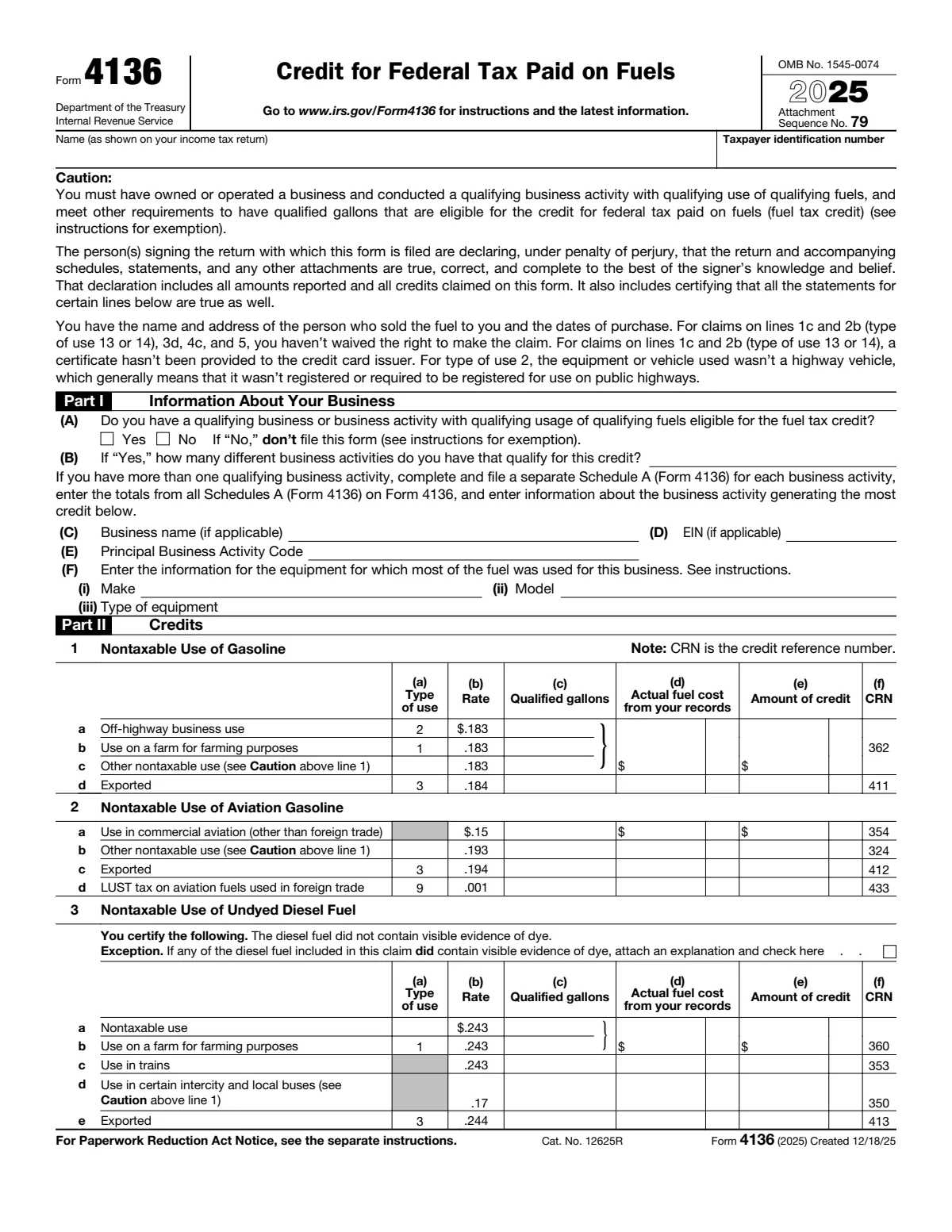
Part I: information about your business
Part I is new for 2025: the instructions say you must complete it to show you qualify for any fuel tax credit.
| Line | Label | What goes there |
|---|---|---|
| Name | Name (as shown on your income tax return) | Form 4136 is an income tax form: it is attached to Form 1040, 1120, 1120-S or 1041 for the tax year. “Partnerships (other than electing large partnerships) can’t file this form.” A partnership passes the gallons to its partners on Schedule K-1. |
| TIN | Taxpayer identification number | The SSN or EIN on that income tax return. |
| A | (A) Qualifying business | “If you answer “No” on line A, you aren’t eligible for the credit, don’t complete Form 4136.” The form's caution says you “must have owned or operated a business and conducted a qualifying business activity with qualifying use of qualifying fuels”. |
| B | (B) Number of business activities | If you have more than one qualifying business activity, file a separate Schedule A (Form 4136) for each, enter the totals from all of them on Form 4136, and describe the activity that generated the most credit on lines C to F. |
| C | (C) Business name | The name of the business whose activity produced the most credit. |
| D | (D) EIN | “Enter on line D the EIN that was issued to you on Form SS-4. Don’t enter your SSN on this line.” Do not use another taxpayer's EIN (for example, from a Form 1099-MISC you received). |
| E | (E) Principal Business Activity Code | “Enter on line E the six-digit principal business activity code.” |
| F | (F) Make, model and type of equipment | “Describe the make, model, and type of the equipment which used most of the fuel that provided your principal source of income on the business reported on line C.” For a carrier claiming reefer fuel, that is the refrigeration unit, not the tractor. |
Part II: the lines a motor carrier uses
Each line asks for the type of use number from the instructions' table, the rate printed on the form, the gallons, the actual fuel cost from your records and the credit (rate times gallons). The rates below are those printed on the 2025 form.
| Line | Label | What goes there |
|---|---|---|
| 1a | Line 1a: nontaxable use of gasoline, off-highway business use | “For line 1a, the gasoline must have been used during the period of claim for a business use other than in a highway vehicle registered (or required to be registered) for highway use (type of use 2).” For a carrier, that is gasoline used in business equipment that is not a registered highway vehicle. Rate $.183 a gallon (2025 form). “Claimant. The ultimate purchaser of the gasoline is the only person eligible to make this claim.” |
| 1de | Line 1, columns (d) to (f) | Column (d), new for 2025, is the actual fuel cost from your records; column (e) is the credit for lines 1a to 1c together; CRN 362. “Don’t include any receipts or explanation with your tax return.” Keep them with your records, as the IRS may ask for proof later. |
| 3-dye | Line 3 certification and dye exception | By claiming on line 3 you certify “The diesel fuel did not contain visible evidence of dye.” Dyed diesel carries no full tax to refund: “Only the $0.001 LUST tax applies to dyed diesel fuel and dyed kerosene”. See dyed diesel. |
| 3a | Line 3a: nontaxable use of undyed diesel fuel | “For line 3a, the diesel fuel must have been used during the period of claim for type of use 2, 6, 7, 8, 11, 13, 14, or 15.” For a motor carrier the usual one is type of use 2, off-highway business use. Pub. 510 says “Off-highway business use includes fuel used in a separate motor to operate special equipment, such as a refrigeration unit, pump, generator, or mixing unit.” But “Off-highway business use doesn't include any fuel used in the propulsion motor of a registered highway vehicle even though that motor also operates special equipment by means of a power take-off or power transfer.” Rate $.243 a gallon (2025 form). |
| 3de | Lines 3a and 3b, columns (d) to (f) | Actual fuel cost from your records in column (d); the credit for lines 3a and 3b together in column (e); CRN 360. Column (a) asks for the type of use number for line 3a (2 for reefer or off-highway use). |
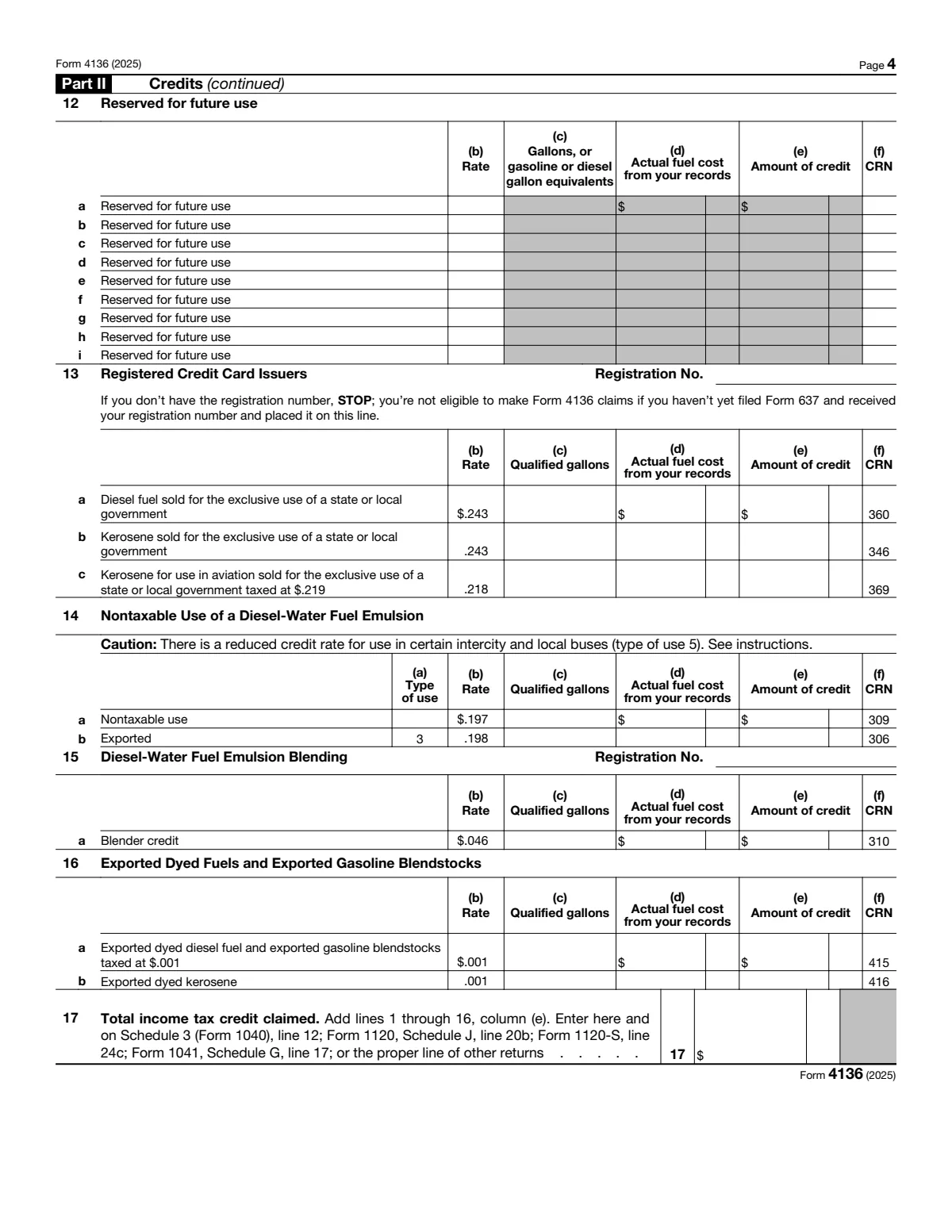
| 17 | Line 17: total income tax credit claimed | Add lines 1 through 16, column (e), and enter the total on Schedule 3 (Form 1040), line 12; Form 1120, Schedule J, line 20b; Form 1120-S, line 24c; Form 1041, Schedule G, line 17; or the proper line of another return (the form's own list). |
Lines a motor carrier does not use
These lines are on the form for other businesses. They have no boxes on the image above and no notes here.
| Lines | What they cover | Who uses them |
|---|---|---|
| 2a to 2d | Aviation gasoline | Aircraft |
| 3b, 3c, 3d, 3e | Undyed diesel on a farm, in trains, in certain buses, exported | Farms, railroads, bus operators, exporters |
| 4 and 5 | Undyed kerosene; kerosene used in aviation | Heating, motorboats, aviation |
| 6 to 8, 13 | Sales by registered ultimate vendors; registered credit card issuers | Fuel sellers registered with the IRS |
| 9, 10 and 12 | Reserved for future use (2025) | Nobody |
| 11 | Nontaxable use of alternative fuel | Off-highway users of CNG, LNG, propane and others |
| 14 to 16 | Diesel-water fuel emulsion; exported dyed fuels and blendstocks | Blenders and exporters |
Form 4136 once a year, or Form 8849 Schedule 1 during the year
Form 4136 is an annual credit. The instructions also allow, instead of waiting, a periodic refund on Form 8849 (Schedule 1, nontaxable use of fuels). The Schedule 1 rules set a floor and a window: “The amount claimed on Schedule 1 must be at least $750.” “The claim must be filed during the first quarter following the last quarter included in the claim.” Gallons claimed on one cannot be claimed on the other: the instructions warn that you cannot claim on Form 4136 any amounts you claimed on Form 8849. The fuel tax refunds guide compares the two routes.
State fuel tax is a separate claim
Form 4136 returns only the federal tax. State fuel tax paid on reefer or other off-highway fuel is claimed from the state: under the IFTA Articles of Agreement, “Licensees must submit claims for refund for tax paid on tax-exempt fuel directly to the respective jurisdiction.” For how reefer fuel is handled on the IFTA return, see the fuel tax refunds guide, the quarterly return guide and your base jurisdiction's page.
How it connects
- When fuel tax comes back and which form to use: reefer and off-highway fuel tax refunds.
- The tax being refunded: federal diesel and gasoline excise tax rates.
- Dyed fuel: dyed diesel rules and penalties.
- The other federal trucking forms: Form 2290 and Form 8849 Schedule 6.
Questions filers ask
Can I claim the fuel my truck engine burns to run a PTO?
No. Pub. 510 says off-highway business use does not include fuel used in the propulsion motor of a registered highway vehicle, even when that motor runs special equipment by a power take-off.
Which line is reefer fuel?
Undyed diesel used in a refrigeration unit with its own motor is off-highway business use: line 3a, type of use 2, at the $.243 rate on the 2025 form.
Do I send fuel receipts with Form 4136?
No. The instructions say not to include receipts or an explanation with the return. Keep them with your records for at least 3 years; column (d) asks for the actual fuel cost, and the IRS may ask for proof.
Can an owner-operator who files Schedule C use Form 4136?
Yes, if the business had qualifying use of the fuel; the credit goes on Schedule 3 (Form 1040). Partnerships cannot file the form; their partners claim their share.
Does Form 4136 also refund state fuel tax?
No. It covers only the federal tax. State fuel tax on exempt fuel is claimed from each state.