- Who files
- IFTA licensees based in Oregon
- Due
- Last day of the month after the quarter (postmark)
- Filed with
- ODOT Commerce and Compliance Division, mail or online
- Form revision
- 735-9740 (03-26)
- Interest printed
- 0.0075 a month on tax due
At a glance
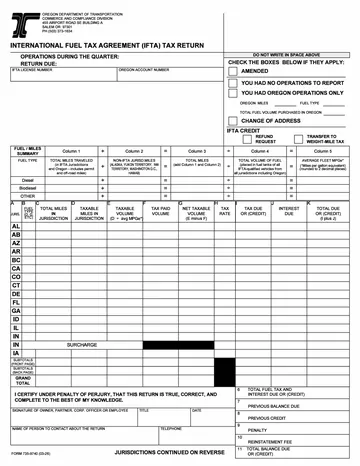
Oregon's IFTA return is the International Fuel Tax Agreement (IFTA) Tax Return, form 735-9740 (03-26), a two-sided return with its filing instructions. “A return is REQUIRED for each quarter, even when” no fuel tax is due. This page follows the form and the ODOT instructions printed with it. It is general information, not tax advice.
- Mail or online. “Oregon IFTA tax returns can be filed by mail or log into your Oregon Trucking Online account to file electronically.” One limit: a fleet that operated “but did NOT accrue miles in Oregon, you cannot file online.”
- On time means postmarked. The return must be signed, paid and carry a U.S. Postal Service cancellation dated on or before the due date. “Customer operated postage machine stamps” are not the same as a postmark.
- 2026 due dates (printed on the form). First quarter April 30, 2026; second quarter July 31, 2026; third quarter November 2, 2026; fourth quarter February 1, 2027.
- Oregon is different. Heavy trucks in Oregon pay the weight-mile tax, and the Oregon line on the back takes all Oregon miles and fuel. See the Oregon IFTA page.
Tap a box once for its note, again to jump to the line. Zoom in to read the small print.
Top of the return
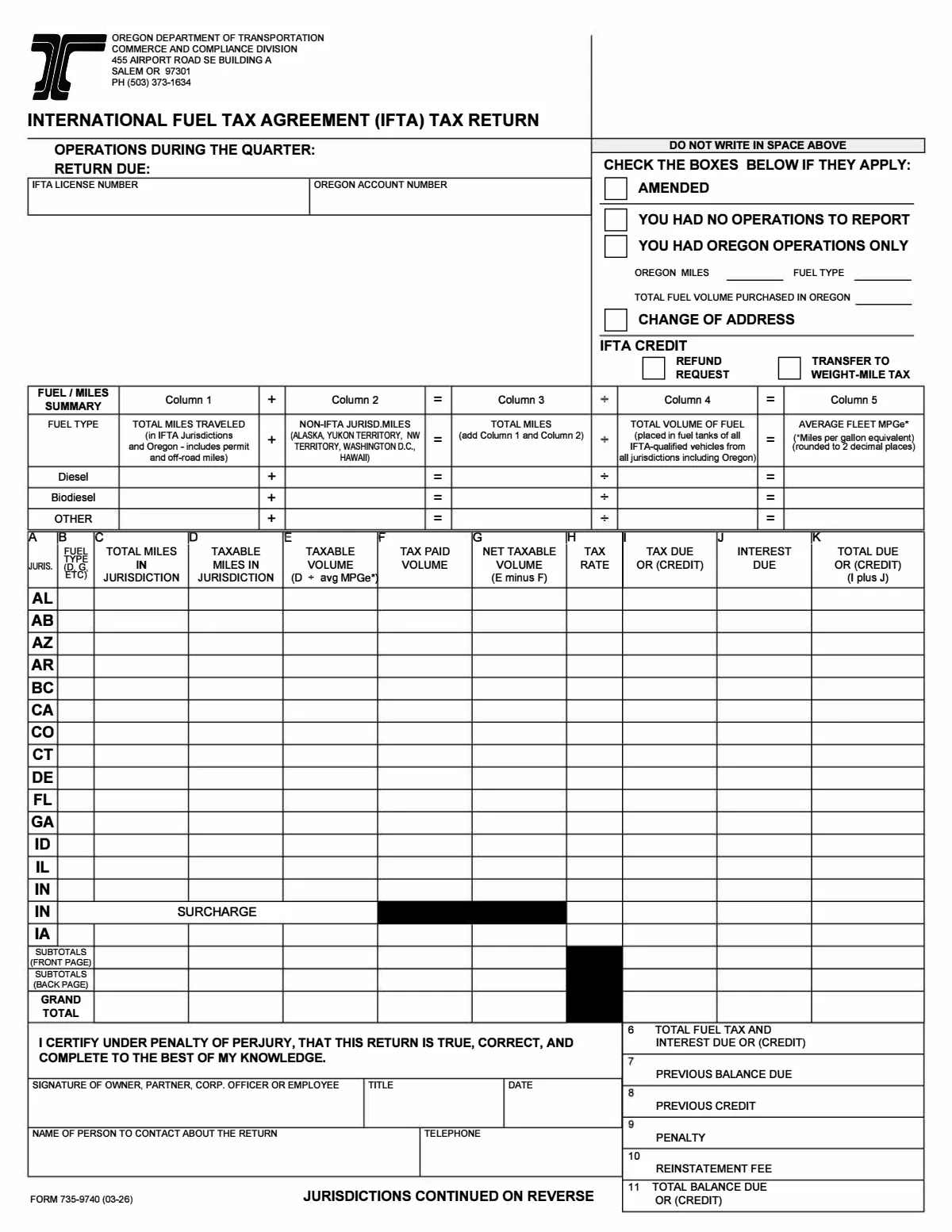
| Box | Label | What goes there |
|---|---|---|
| Quarter | Operations during the quarter; Return due | Preprinted on the return ODOT mails. “This return is to be used only by the” motor carrier whose name is printed on it; ask the IFTA unit for a duplicate if one did not arrive. |
| License | IFTA license number | Your Oregon IFTA license number (P720.100). |
| Account | Oregon account number | Your Commerce and Compliance Division account number, also used for weight-mile tax. |
| Amended | Amended | Make a copy of the original return, “check the AMENDED box at the” top and write the changes next to the wrong figures, with an explanation. Late amendments can draw penalty and interest. |
| NoOps | You had no operations to report | “Check this box if none of your qualified vehicles” had operations in the quarter. A return is still due. |
| ORonly | You had Oregon operations only; Oregon miles, fuel type, total fuel volume purchased in Oregon | “Check this box if all of your” qualified vehicles operated in Oregon only, and fill in the Oregon miles, fuel type and fuel bought in Oregon in the space at the upper right. |
| Address | Change of address | Check it, mark through the wrong address and print the right one. |
| Credit | IFTA credit: Refund request, Transfer to weight-mile tax | “To transfer your credit to weight-mile tax, or to” request a refund, check the box. “Refunds may take up to 90 days to process.” The transfer is Oregon's own option for carriers that also file the weight-mile tax report. |
Fuel/miles summary (Columns 1 to 5)
The summary works out the fleet's miles per gallon (MPGe for alternative fuels) for each fuel type. Everything in Column E depends on it.
| Column | Label | What goes there |
|---|---|---|
| FuelType | Fuel/miles summary: Fuel type | Each fuel on its own line (Diesel, Biodiesel, OTHER). “If biodiesel and diesel were placed into the same fuel tank and thus combined; report as 'Diesel'.” |
| Col1 | Column 1: Total miles traveled | All miles in IFTA jurisdictions including Oregon. “Include permit and off-road miles.” Round to the whole number; explain if the fleet had no Oregon miles. |
| Col2 | Column 2: Non-IFTA jurisdiction miles | Miles in Alaska, Hawaii, Washington D.C., the Northwest Territories, Yukon or another non-IFTA place, including off-road miles there. Do not put Oregon miles here. |
| Col3 | Column 3: Total miles | “Columns 1 and 2 MUST EQUAL Column 3.” |
| Col4 | Column 4: Total volume of fuel | All fuel placed in the fuel tanks of your IFTA-qualified vehicles from all jurisdictions, including Oregon, rounded to the whole number. |
| Col5 | Column 5: Average fleet MPGe | Column 3 divided by Column 4. “Carry this calculation to three” decimal places, “then ROUND to two decimal places.” A sanity check from the instructions: “MPGe is typically .50 through 20.” |
Columns A to K: one line per jurisdiction
| Column | Label | What goes there |
|---|---|---|
| A | A. Juris. | Preprinted, front and back. Every jurisdiction where you ran gets a line. |
| B | B. Fuel type (D, G, etc.) | The fuel code: B biodiesel, D diesel, G gasoline, P propane, CNG, LNG, E ethanol, M methanol, EL electricity, HD hydrogen and others listed on the instructions. Use a separate sheet if you used more than one fuel in a jurisdiction. |
| C | C. Total miles in jurisdiction | All miles in each jurisdiction for each fuel, including “off-road miles and permit miles. The GRAND TOTAL of Column C” “MUST EQUAL the totals in Column 1.” |
| D | D. Taxable miles in jurisdiction | Taxable miles in each IFTA jurisdiction. “Do not include off-road nontaxable miles or fuel tax permit miles in” this column. See taxable miles. |
| E | E. Taxable volume (D / avg MPGe) | “Divide the amount in Column D” by the Column 5 MPGe for that fuel and round to the whole number. |
| F | F. Tax paid volume | Fuel bought in the jurisdiction this quarter with tax paid, rounded. “Purchases must be supported by invoices from the vendor and” kept in your records. All Oregon fuel placed in an IFTA vehicle “must be reported on the detail line for” Oregon. |
| G | G. Net taxable volume (E minus F) | Column E minus Column F; a credit takes a minus sign. |
| H | H. Tax rate | From the rate table for the same quarter. “Tax rate tables change each quarter.” Online filing applies the rates for you. |
| I | I. Tax due or (credit) | Column G times Column H, in dollars and cents; a credit takes a minus sign. |
| J | J. Interest due | Only for a late return, and only where tax is due: Column I times “0.0075 for each month or partial month the report” is late. “Do not calculate interest on credit amounts in Column I.” The agreement sets the interest rate each year for U.S.-based fleets (R1230.100): two points above the IRS underpayment rate, and “Interest shall accrue monthly at 1/12 this annual rate.” A monthly rate printed on a form can be older than the current one; check it against the penalties and interest guide or the penalty and interest estimator. |
| K | K. Total due or (credit) (I plus J) | Columns I and J added; a credit takes a minus sign. |
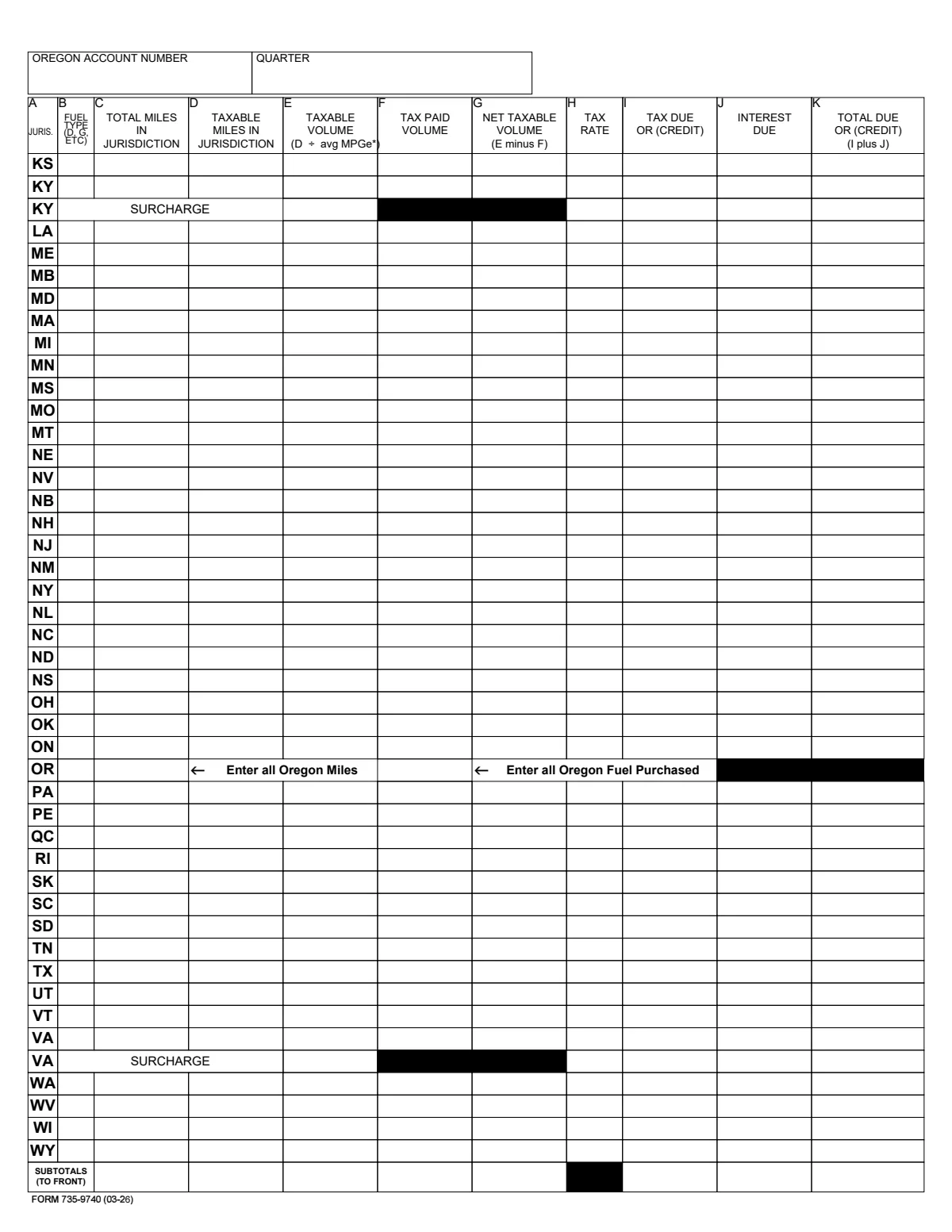
| Surcharge | SURCHARGE lines (Indiana on the front; Kentucky and Virginia on the back) | “Currently, Indiana, Kentucky, and Virginia levy a” surcharge. On the second line for each, multiply the taxable volume (Column E) by the surcharge rate. Columns F and G are blacked out there. |
| Totals | Subtotals (front page), subtotals (back page), grand total | Add each column on both pages; the back-page subtotals come forward. The grand total of Column K goes to line 6. |
Worked line: Column 5 is 6.40 MPGe. Idaho Column D is 1,600 taxable miles, so Column E is 250 gallons. With 400 tax-paid gallons bought in Idaho (Column F), Column G is -150: a credit, carried with its minus sign through Columns I and K. Try it in the quarterly return calculator.
Lines 6 to 11, signature and the back page
| Line | Label | What goes there |
|---|---|---|
| 6 | 6. Total fuel tax and interest due or (credit) | Total “of all amounts in Column K. Remember to subtract credits.” |
| 7 | 7. Previous balance due | Added when it applies: an unpaid balance from a partial payment, an error, a penalty or interest on an earlier return. |
| 8 | 8. Previous credit | “This amount is subtracted from the total” due. Check that the credit is valid and unused; you may also keep it for later and send full payment. |
| 9 | 9. Penalty | “If this return is filed late, enter 10% of the total” “amount of Column I, or $50, whichever is greater.” That is the P720.600 standard. |
| 10 | 10. Reinstatement fee | If your account was revoked and you need to reinstate, “include a $25 reinstatement fee.” |
| 11 | 11. Total balance due or (credit) | “This is the total of lines” 6 through 10, with line 8 as a credit. Attach payment: a check or money order “payable to ODOT with IFTA in the memo line,” mailed to the Commerce and Compliance Division, 455 Airport Road SE, Building A, Salem, Oregon 97301. |
| Sign | Certification, signature, title, date, contact name, telephone | Signed by the owner, a partner, a corporate officer or an employee, certifying under penalty of perjury. All four P720 signer elements are printed: signature, title, date and telephone. |
| P2-Head | Oregon account number, Quarter (back page) | Repeat them on the back page. |
| OR | OR line | The printed arrows say it: enter all Oregon miles and all Oregon fuel purchased on this line; the interest and total due cells are blacked out. Oregon reaches heavy trucks through the weight-mile tax, and ODOT's manual notes that “Diesel vehicles usually do not pay Oregon state fuel tax at the pump.” The Oregon miles and fuel still count in your fleet MPGe. |
| Back-sub | Subtotals (to front) | Column subtotals of the back page, carried to the SUBTOTALS (BACK PAGE) line on the front. |
How the columns follow P720
Every member jurisdiction prints its own return, but the IFTA Procedures Manual sets what each one must hold. P720 says “Each jurisdiction shall provide, at a minimum, the following elements to be present on a standard tax return.” and P700 adds that the elements apply “regardless of the method of completion of the tax return”. The table matches the P720 list to the boxes on this form, so you can check a return line by line against the agreement.
| P720 | Element the agreement requires | Where it is on this form |
|---|---|---|
| P720.050 | Jurisdiction's name and mailing address | Top left: ODOT Commerce and Compliance Division, 455 Airport Road SE, Salem |
| P720.100 and .150 | License number; licensee name and address | IFTA License Number; name and address preprinted on the mailed return |
| P720.200 | Tax reporting period | Operations During the Quarter |
| P720.250 to .400 | Total distance, total fuel, average factor, fuel type | Fuel/Miles Summary, Columns 3, 4 and 5, one line per fuel |
| P720.500 .010 to .050 | Rate, total miles, taxable miles, taxable volume, tax-paid volume, net taxable volume, tax, interest, total | Columns H, C, D, E, F, G, I, J, K |
| P720.550 | Column totals | Subtotals (front and back) and Grand Total |
| P720.600 and .650 | Penalty; total remittance | Lines 9 and 11 (previous balances on lines 7 and 8, as P720 allows) |
| P720.700 to .850 | Date, signature, title, phone | Certification block |
Rules that trip people up
- Column C keeps off-road and permit miles; Column D drops them. The Column C grand total must equal Column 1.
- All Oregon fuel and all Oregon miles go on the OR line on the back, even though Oregon charges no IFTA tax for them.
- Records back every figure: “available for at least four years from” the due date or filing date. Without them an audit may end up “assessing fleet miles per gallon to 4.0 mpg, or both.”
- A credit can go back as a refund or to your weight-mile tax account; check one box only.
How it connects
- The method behind every column: how to file an IFTA quarterly return, step by step, and the quarterly return calculator, which runs the same P720 worksheet in your browser.
- Taxable and total miles: taxable miles vs total miles.
- Tax-paid gallons and receipts: tax-paid fuel credits and what a fuel receipt must show.
- Surcharge lines: IFTA surcharge jurisdictions.
- Dates, late filing and corrections: IFTA due dates, penalties and interest, zero returns and amended returns and refunds.
- Rates: the fuel tax rate lookup, built from the jurisdictions' own rate notices.
- Oregon's own tax on heavy trucks: the Oregon weight-mile tax and the form 735-9002 page. Oregon license and decals: the Oregon IFTA guide.
Questions filers ask
Why is the Oregon line different?
Heavy trucks in Oregon pay the weight-mile tax, and ODOT's manual says diesel vehicles usually do not pay Oregon fuel tax at the pump. The return still wants all Oregon miles and fuel on the OR line, because they count in your fleet's miles per gallon.
Can I file the Oregon IFTA return online?
Yes, through Oregon Trucking Online, except a fleet that operated but had no Oregon miles: the instructions say it cannot file online.
What interest does the Oregon form use?
The instructions print 0.0075 for each month or partial month late, on tax due only. The agreement resets the IFTA rate every January 1, so check the current rate before you rely on a printed figure.
Can I move an IFTA credit to my weight-mile tax account?
Yes. Check Transfer to Weight-Mile Tax under IFTA Credit at the top of the return. Transfers and refunds are subject to verification.