- Who files
- Holders of a New York HUT certificate
- How often
- Quarterly, monthly or annually by last year's tax
- Due
- Last day of the month after the period
- Filed with
- NYS Department of Taxation and Finance
- Form revision
- MT-903 (10/23)
At a glance
Form MT-903, Highway Use Tax Return (10/23), reports New York's highway use tax (HUT): a tax on heavy trucks and tractors, figured by weight and by the miles they run on New York public highways off the toll-paid Thruway. This page follows the form and its instructions, Form MT-903-I (1/22). It is general information, not tax advice.
- Who files. “You must file Form MT-903, Highway Use Tax Return, if you” have been issued a certificate of registration or operate a motor vehicle in New York State, as Tax Law Article 21 defines it. See the New York HUT guide.
- How often. Quarterly for most carriers; monthly when last year's tax was over $12,000; annually at $1,200 or less.
- Paper or online. The Tax Department's filing page offers Web File for the HUT return; the form is mailed otherwise.
- Two methods. Gross weight or unloaded weight, picked on the first return of the year for every vehicle and kept all year.
Tap a box once for its note, again to jump to the line. Zoom in to read the small print.
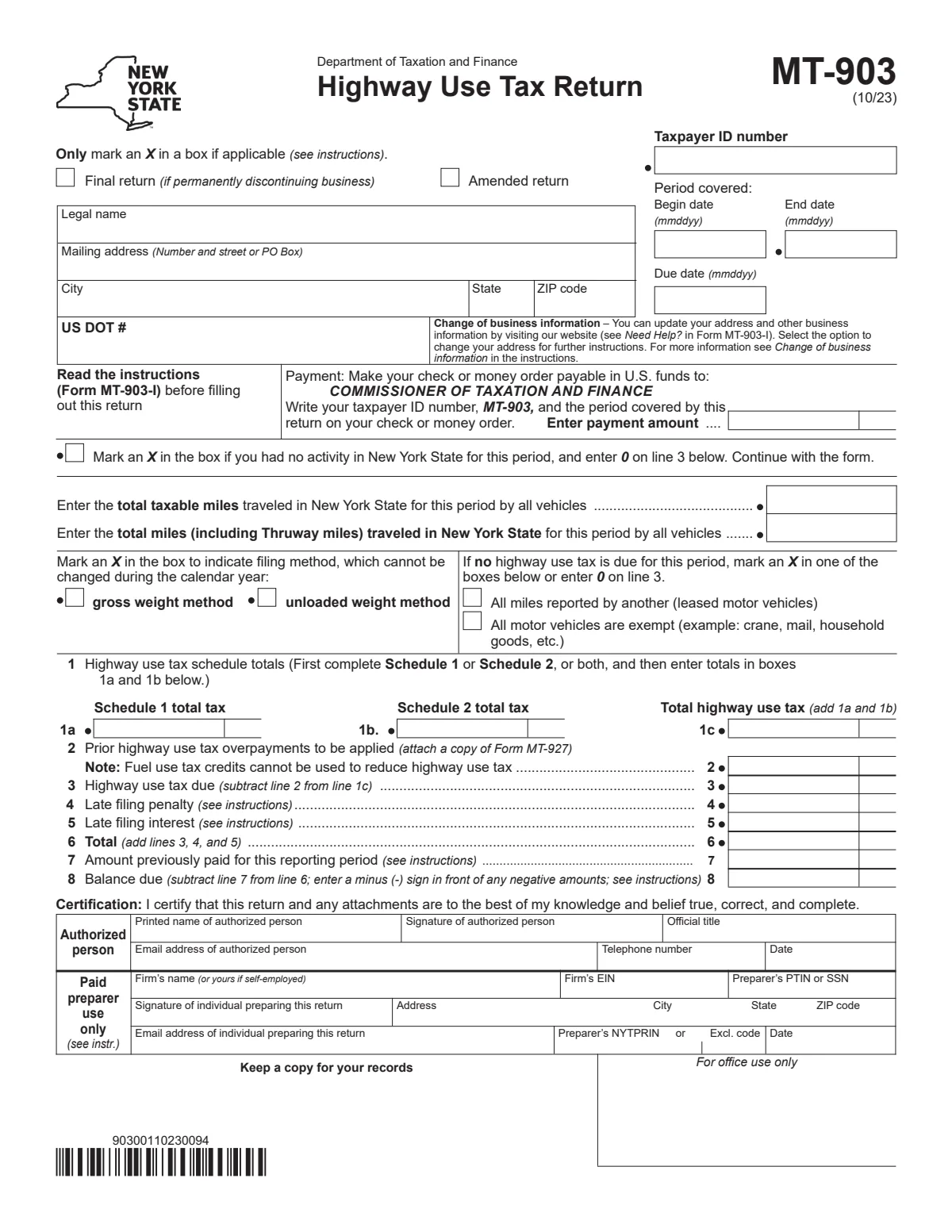
Front page: who, when and the miles
| Box | Label | What goes there |
|---|---|---|
| TaxID | Taxpayer ID number | The ID on your highway use tax account. “you must file a HUT return even if no tax is due”, once you hold a certificate of registration. |
| Final-Amended | Final return; Amended return | Final: “If you are permanently discontinuing your business for highway” use tax purposes, mark it and return your certificates and decals. Amended: “The amended return must indicate the correct figures for” the period, not the difference, and “A full explanation of the changes” must go with it. |
| Period | Period covered: Begin date, End date (mmddyy) | “Form MT-903 is filed monthly, annually, or quarterly, based on” the previous full calendar year's tax: monthly above $12,000, annually at $1,200 or less, quarterly for everyone else and for new carriers. |
| Due | Due date (mmddyy) | “Form MT-903 is due by the last day of the month following the” end of the reporting period. “postmark date as the filing date for returns and payments.” |
| Name | Legal name, mailing address, city, state, ZIP | As on your HUT account. |
| USDOT | US DOT # | Your USDOT number (see the MCS-150 form page). |
| Change | Change of business information | An address change is fastest online; you may also attach Form DTF-96. Other account changes go on Form DTF-95. |
| Payment | Payment: enter payment amount | Make the check or money order payable to Commissioner of Taxation and Finance, with your taxpayer ID, MT-903 and the period on it. Mail to NYS Tax Department, RPC - HUT, PO Box 15166, Albany NY 12212-5166 (the instructions' address). |
| NoActivity | No activity in New York State | If you had no activity, “mark an X in the appropriate box and enter 0 on line 3.” Continue with the form and file it. |
| TaxableMiles | Total taxable miles traveled in New York State | Taxable miles of all vehicles this period. “Do not report mileage traveled on the toll-paid portion of the” New York State Thruway, or miles of buses and other exempt or excluded vehicles. |
| TotalMiles | Total miles (including Thruway miles) traveled in New York State | All New York miles of all vehicles, Thruway included. |
| Method | Filing method: gross weight method or unloaded weight method | “When you file your first return for the calendar year, you must” choose one. “You may not change the method selected.” “The method must be used for all of your vehicles.” Gross weight: every truck and tractor over 18,000 pounds gross. Unloaded weight: “every truck having an unloaded weight of over 8,000 pounds” “and every tractor having an unloaded weight of over 4,000” pounds. |
| NoTax | If no highway use tax is due | Mark All miles reported by another (leased motor vehicles) or All motor vehicles are exempt (crane, mail, household goods and so on), or enter 0 on line 3. |
Lines 1 to 8
“First complete Schedule 1 or Schedule 2, or both, and then enter totals in boxes” 1a and 1b.
| Line | Label | What goes there |
|---|---|---|
| 1a | 1a. Schedule 1 total tax | “Enter the amount of total tax from Schedule 1, line 16.” |
| 1b | 1b. Schedule 2 total tax | The total tax from Schedule 2, line 24. |
| 1c | 1c. Total highway use tax (add 1a and 1b) | Line 1a plus line 1b. |
| 2 | 2. Prior highway use tax overpayments to be applied | Attach a copy of Form MT-927. “Do not enter more than the amount on line” 1c. The form adds: “Note: Fuel use tax credits cannot be used to reduce highway use tax”. Your IFTA credits stay on the IFTA return. |
| 3 | 3. Highway use tax due (line 1c minus line 2) | The tax for the period. 0 if you marked No activity or a no-tax box. |
| 4 | 4. Late filing penalty | If you file late or do not pay in full, you owe penalty and interest. The Tax Department's website estimates both, or you can call and it will compute them. |
| 5 | 5. Late filing interest | Interest rates are “adjusted quarterly and compounded daily.” |
| 6 | 6. Total (add lines 3, 4, and 5) | Lines 3, 4 and 5 added. |
| 7 | 7. Amount previously paid for this reporting period | “Enter an amount on this line only if you are amending” a previously filed return and marked Amended: the total you paid with it, penalty and interest included. |
| 8 | 8. Balance due (line 6 minus line 7) | Pay this amount. “If your balance due is a negative amount for this reporting” period, a refund is claimed separately on Form DTF-406. |
| Cert | Certification: authorized person | Sign and date, with your official title, telephone number and e-mail. “Only the taxpayer or an authorized agent” “may sign the return.” |
| Preparer | Paid preparer use only | Anyone paid to prepare the return who is not an employee, owner, partner or officer completes this section in full, with the federal PTIN (or SSN) and a NYTPRIN or exclusion code. |
Schedule 1
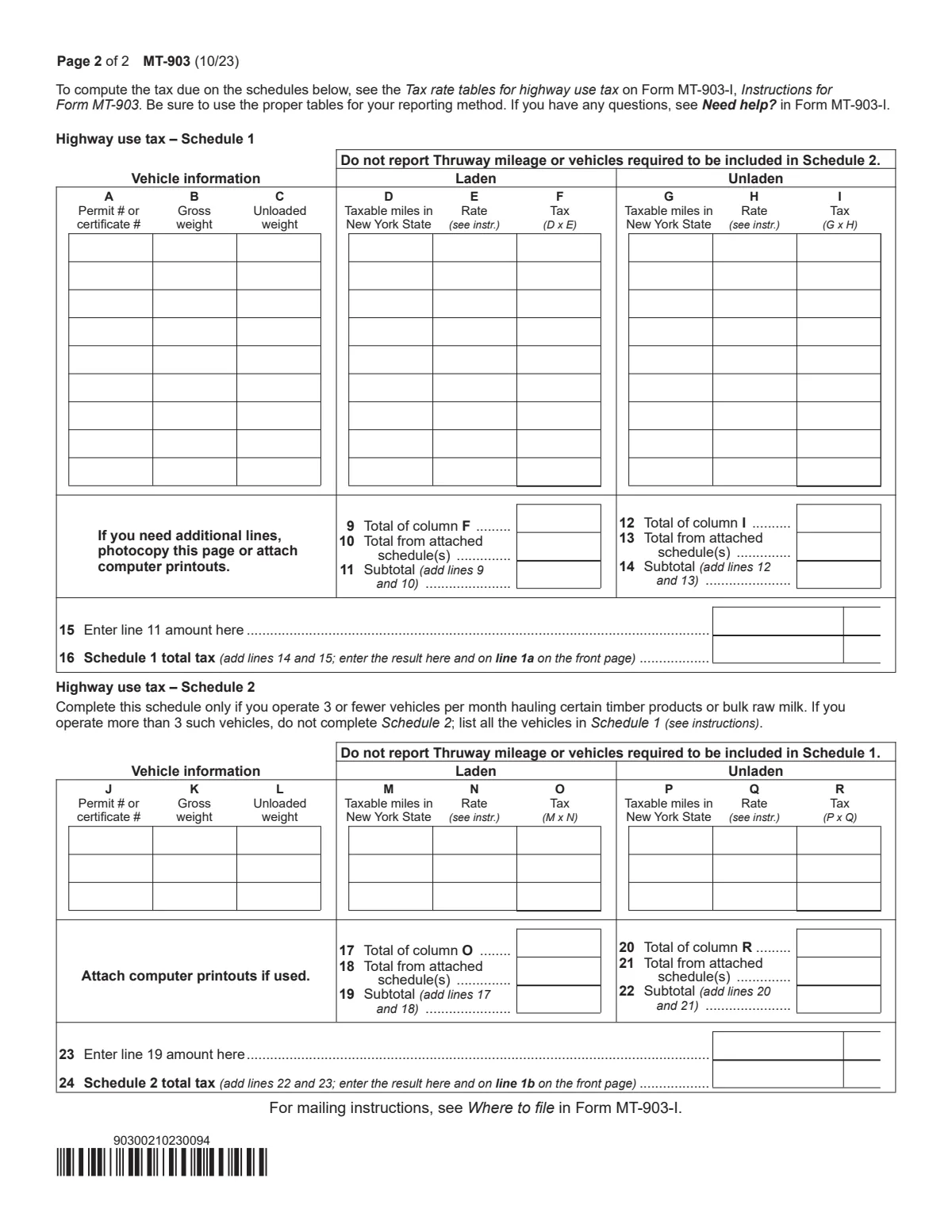
Schedule 1 taxes every non-Thruway New York mile except Schedule 2 mileage. “Do not report Thruway mileage or vehicles required to be included in Schedule 2.” The rates are in the tables at the end of MT-903-I; which table depends on the method you marked.
| Column or line | Label | What goes there |
|---|---|---|
| A-C | Schedule 1, Columns A to C: Permit # or certificate #, gross weight, unloaded weight | Under the gross weight method, straight line option: “List the current certificate number of each truck and” each tractor you operated on New York State public highways, tractors first, then trucks, then vehicles on certificates of others. A tractor or truck that runs both with and without a trailer is listed twice. Column B is the gross weight on the certificate; Column C the unloaded weight. The heaviest weight option lists categories instead of every vehicle; the unloaded weight method leaves Column B blank. |
| D | D. Laden taxable miles in New York State | “Enter the total laden non-Thruway miles traveled” in New York State by each vehicle in Column A (by category under the heaviest weight option). Laden means with a load or any part of one. Left blank under the unloaded weight method. |
| E | E. Laden rate (see instr.) | The rate for the vehicle's gross weight in Column B from Table 1 of MT-903-I, Laden non-Thruway miles, tractors and trucks. |
| F | F. Laden tax (D x E) | Column D times Column E. |
| G | G. Unladen taxable miles in New York State | “Enter the total unladen non-Thruway miles traveled” in New York State by each vehicle. Under the unloaded weight method, all non-Thruway miles go here. |
| H | H. Unladen rate (see instr.) | The rate for the unloaded weight in Column C, from Table 2 or 3 (gross weight method) or Table 4 or 5 (unloaded weight method). |
| I | I. Unladen tax (G x H) | Column G times Column H. |
| 9-11 | Lines 9, 10, 11: Total of column F, total from attached schedules, subtotal | Laden tax on this page, plus any attached continuation pages. |
| 12-14 | Lines 12, 13, 14: Total of column I, total from attached schedules, subtotal | Unladen tax on this page, plus attached pages. |
| 15 | 15. Enter line 11 amount here | The laden subtotal from line 11. |
| 16 | 16. Schedule 1 total tax | Line 14 plus line 15. Enter it here and on line 1a. |
Schedule 2
“You may use this schedule only if you have three or fewer” trucks or tractors that qualify; with more, all mileage goes on Schedule 1.
| Column or line | Label | What goes there |
|---|---|---|
| J-L | Schedule 2, Columns J to L: certificate #, gross weight, unloaded weight | “Complete this schedule only if you operate 3 or fewer vehicles per month hauling certain timber products or bulk raw milk.” The products are boltwood, logs, pulpwood, wood chips and raw, unprocessed milk in bulk. “Almost exclusively means 90% or more of a motor vehicle’s” monthly New York laden miles, decided month by month. |
| M-O | M to O: laden taxable miles, rate (Table 6), tax (M x N) | Laden non-Thruway miles of each vehicle times the Schedule 2 rate from Table 6. Left blank under the unloaded weight method. |
| P-R | P to R: unladen taxable miles, rate (Tables 7 to 10), tax (P x Q) | Unladen non-Thruway miles (all non-Thruway miles under the unloaded weight method) times the Schedule 2 rate. |
| 17-19 | Lines 17, 18, 19: Total of column O, attached schedules, subtotal | Schedule 2 laden tax. |
| 20-22 | Lines 20, 21, 22: Total of column R, attached schedules, subtotal | Schedule 2 unladen tax. |
| 23 | 23. Enter line 19 amount here | The Schedule 2 laden subtotal. |
| 24 | 24. Schedule 2 total tax | Line 22 plus line 23. Enter it here and on line 1b. |
HUT and IFTA are separate
The HUT return taxes miles by weight; New York's fuel use tax rides on the IFTA return. MT-903-I says that if you are licensed under IFTA, “you must pay the New York fuel use tax on your IFTA” report filed with your base jurisdiction. The two do not offset each other: line 2 bars IFTA credits from reducing HUT. A carrier based anywhere that runs heavy trucks in New York can owe both. See weight-distance taxes compared.
Rules that trip people up
- Thruway toll-paid miles are left out of taxable miles but included in the total miles line.
- The method is chosen once a year, on the first return, for every vehicle.
- A tractor or truck that runs both with and without a trailer is listed twice under the gross weight method.
- A negative balance is not refunded from the return: claim it on Form DTF-406.
- File every period with a certificate, even with no New York miles: mark No activity and enter 0 on line 3.
How it connects
- Who must register and how the tax works: the New York highway use tax guide.
- Which states add a weight-distance tax and how they differ: weight-distance taxes compared and the weight-distance tax checker.
- Deadlines across all your filings: the deadline calendar. New York's IFTA rules: the New York IFTA page.
Questions filers ask
Do I file MT-903 if my trucks did not enter New York this quarter?
Yes, if you hold a HUT certificate. Mark the No activity box, enter 0 on line 3 and file. The Tax Department says a HUT return is due even if no tax is due.
Do I report Thruway miles on MT-903?
Only in the total miles line. Miles on the toll-paid portion of the Thruway are not taxable miles and stay off Schedules 1 and 2.
Can I switch from the gross weight method to the unloaded weight method mid-year?
No. You choose on the first return of the calendar year and may not change the method during the year; it applies to all your vehicles.
Can an IFTA credit pay my New York HUT?
No. The form says fuel use tax credits cannot be used to reduce highway use tax. Only prior HUT overpayments go on line 2.
How do I get a HUT overpayment back?
File Form DTF-406, Claim for Highway Use Tax (HUT) Refund, separately; or apply the overpayment on line 2 of a later return within four years.