- Who files
- Interstate motor carriers (and some intrastate hazmat carriers)
- When
- Before operating, then every 24 months
- Update month
- Last digit of the USDOT number
- Filed with
- FMCSA, online or by mail
- Form revision
- February 20, 2026
At a glance
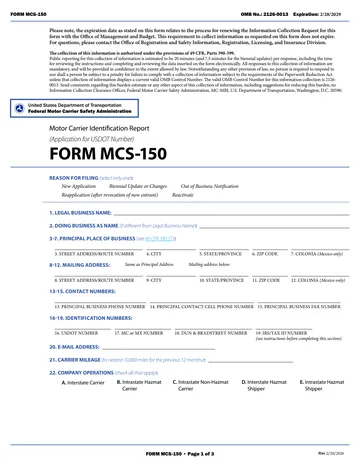
Form MCS-150, Motor Carrier Identification Report (Application for USDOT Number), is the form FMCSA uses to register a motor carrier and to keep its record current. This page follows the form revised February 20, 2026 (OMB No. 2126-0013) and the instructions printed with it. It is general information, not legal advice.
- Who files. Under 49 CFR 390.1949 CFR 390.19Code of Federal Regulations, eCFR, a carrier files “Before it begins operations” and then every 24 months. The USDOT number guide covers who needs a number.
- Why it matters. A carrier that misses the update “will have its USDOT Number deactivated and will be prohibited from conducting transportation.”
- How to file. Online (FMCSA's recommended route) or on paper by mail. “Mailed applications, on average, take four to six weeks processing time.” Paper forms go to FMCSA, Attention: USDOT Number Application, 1200 New Jersey Avenue SE, Room W65-206, Washington, DC 20590 (the address printed in the instructions).
- New system. FMCSA's Federal Register notice of April 29, 2026 describes Motus, its new online registration system, which “will satisfy the statutory mandate for a unified registration system”. Check FMCSA's registration page for where to file online today.
Tap a box once for its note, again to jump to the line. Zoom in to read the small print.
Page 1: who you are
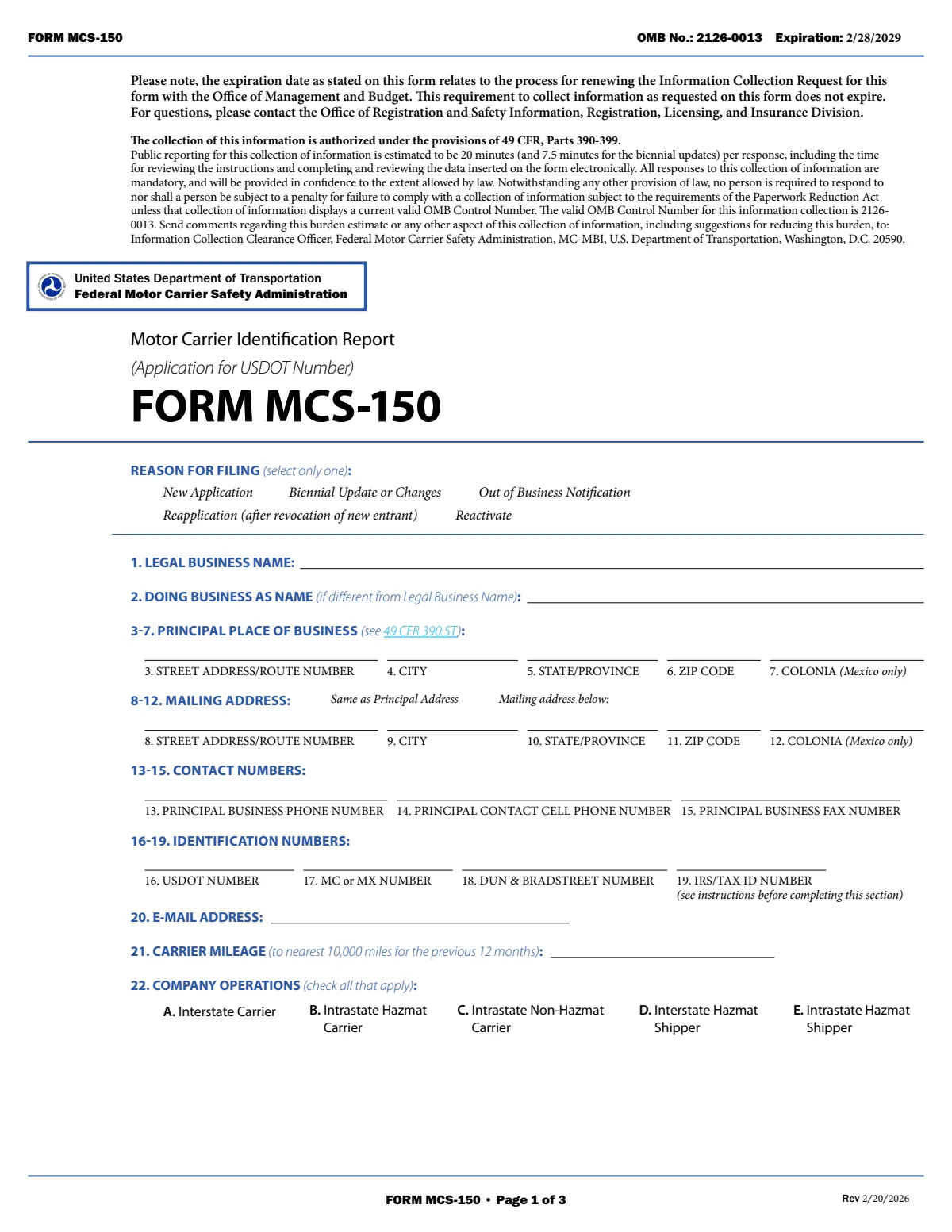
Page 1 identifies the business. Every reason for filing completes items 1 to 16; a biennial update also confirms item 21.
| Item | Label | What goes there |
|---|---|---|
| Reason | Reason for filing (select only one) | “Select one of the four reasons and mark its corresponding box at the top of the form”. What you complete depends on the reason: a new application, “All applicable items (1-31); exclude items 16” and 28; a biennial update, “All applicable items 1-16, 21, 30-31, and” any others that changed; out of business, items 1 to 16 and 30 to 31. If the company ever had a USDOT number, do not file for a new one: reapply, reactivate or update the old one. |
| 1 | Legal business name | “This is the legal name of the business entity that owns/controls the Motor Carrier operation.” A sole proprietor enters their own name; a partnership, the names of all partners; a corporation or LLC, the name on its formation papers including INC or LLC. The rule at 49 CFR 390.19(f)49 CFR 390.19Code of Federal Regulations, eCFR adds: “Only the legal name or a single trade name of the motor carrier may be used on the Form MCS-150.” |
| 2 | Doing business as name | The trade name, only if it differs from item 1. In the instructions' example, an owner-operator's own name goes in item 1 and the trucking company name the public sees goes in item 2. |
| 3-7 | Principal place of business (items 3 to 7) | Street, city, state or province, ZIP and, for Mexico, the colonia. This is where FMCSA comes for audits and investigations, and “FMCSA will not accept a P.O. Box, private mailbox, virtual work center, or other location with no legal or functional relationship” to the business. |
| 8-12 | Mailing address (items 8 to 12) | “Enter the mailing address where the company wants all its FMCSA correspondence to be sent (this may be a P.O. Box).” If every part matches items 3 to 7, check Same as Principal Address and skip the lines. A mailed application's USDOT number is sent here. |
| 13-15 | Contact numbers (items 13 to 15) | Item 13 is the main phone for the principal place of business (a cell phone is fine); item 14 a contact cell phone; item 15 a fax. Write Same in 14 or 15 when the number repeats item 13. |
| 16-19 | Identification numbers (items 16 to 19) | 16: your USDOT number, if you are not a new applicant. 17: an MC or MX number, including one that is pending. 18: a Dun and Bradstreet number, if any. 19: the EIN. “Sole proprietor owner/operators who do not have an EIN may submit their SSN instead of EIN”, but FMCSA encourages an EIN, and an EIN is needed anyway for Form 2290. |
| 20 | E-mail address | The official point of contact's e-mail. For a sole proprietor, note the instructions' warning: personal details given for registration “will be publicly available on FMCSA websites” when they serve as the business contact. |
| 21 | Carrier mileage | “Enter the total mileage of all Commercial Motor Vehicles (CMV) in the company’s operation to the nearest 10,000 miles for the previous 12 months.” Less than a year in business: miles to date. No operation in the last 12 months: 0. Your IFTA and IRP distance records are the natural source; see what records to keep. |
| 22 | Company operations | Check all that apply. You are an interstate carrier if property or passengers cross state lines before, during or after your part of the trip, including a move that starts and ends in one state but passes through another. If you select only a hazmat shipper type (no carrier operation), no USDOT number is needed and no form is filed. |
| 23 | Operation classifications | A: authorized for-hire (paid to haul regulated goods owned by others). B: exempt for-hire (only exempt commodities). C: private property (your own goods). D to K: passenger, migrant, U.S. Mail, government and tribal operations. If you select A, “the company will also be required to obtain Interstate Operating Authority (MC or MX Number)”; see MC number and operating authority. |
Page 2: what you do and what you run
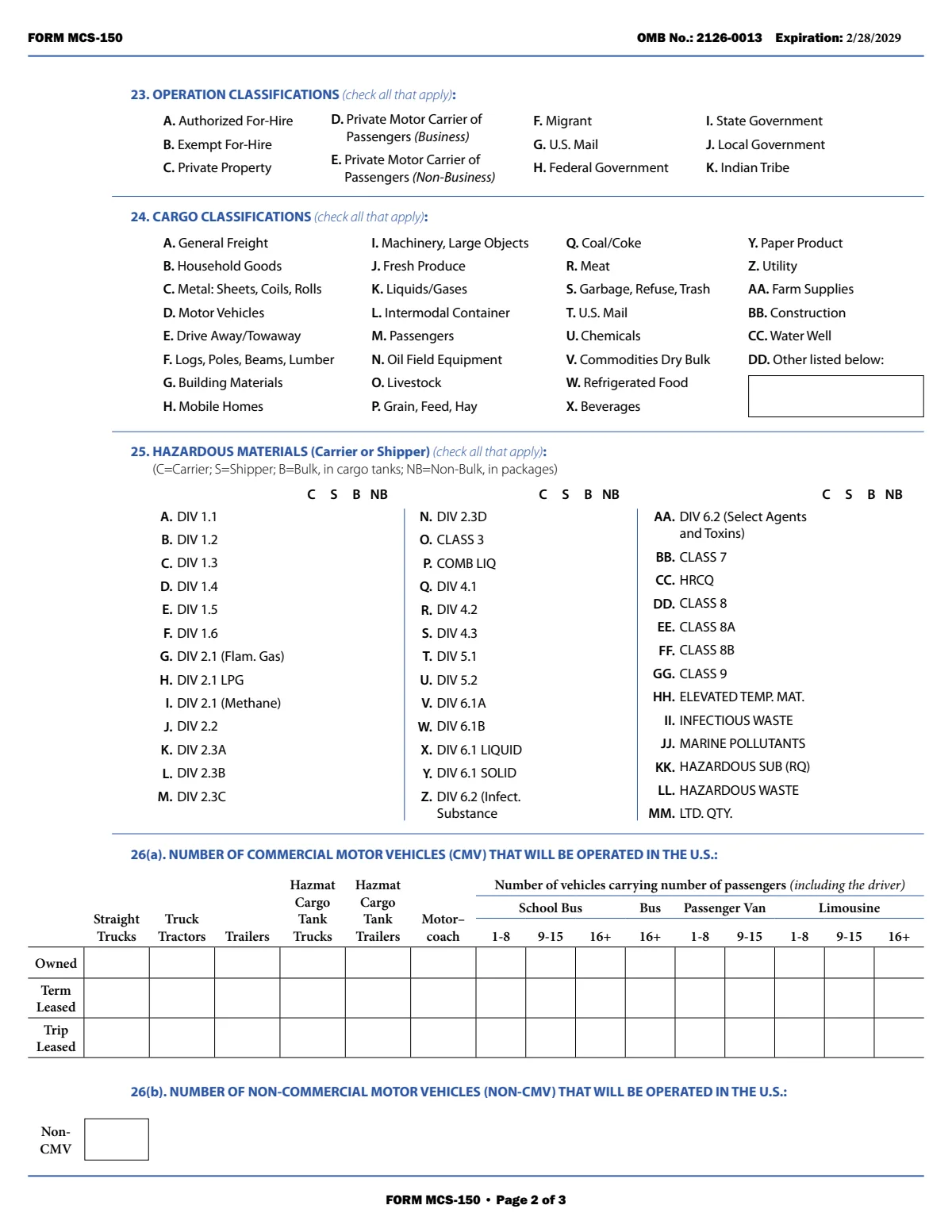
Items 23 to 26 decide which FMCSA rules apply to you and whether you need operating authority. A biennial update completes them only where something changed.
| Item | Label | What goes there |
|---|---|---|
| 24 | Cargo classifications | Check every cargo type you haul, A (general freight) to DD (other, written in). Motor vehicles and drive away/towaway require Class 9 under item 25. Passengers (M) means you use motorcoaches, buses, vans or limousines, not a rider helping the driver. |
| 25 | Hazardous materials | Complete only if you transport or ship hazmat. Mark C (carrier) or S (shipper), and B (bulk, in cargo tanks) or NB (non-bulk, in packages), next to each class and division you handle. Hazmat carriers and shippers may also need to register with PHMSA. |
| 26a | Number of commercial motor vehicles | Count each kind of vehicle you use in the U.S. by how you hold it: owned (you hold title), term leased (a lease for a set term) or trip leased (trip by trip). Passenger vehicles are counted by seating, including the driver. Example from the instructions: 3 owned straight trucks and 1 owned trailer, plus 2 term-leased trailers. |
| 26b | Number of non-commercial motor vehicles | Vehicles under the CMV thresholds that you use to haul federally regulated commodities owned by others and that need operating authority. |
| 27 | Driver information | Interstate and intrastate drivers on an average workday, split by whether they stay within a 100 air-mile radius of their work-reporting location, then total drivers and total CDL drivers. Count part-time, casual, leased and company drivers. “The total number of drivers should be equal to all interstate plus all intrastate drivers.” |
Page 3: drivers, revocation and signature
| Item | Label | What goes there |
|---|---|---|
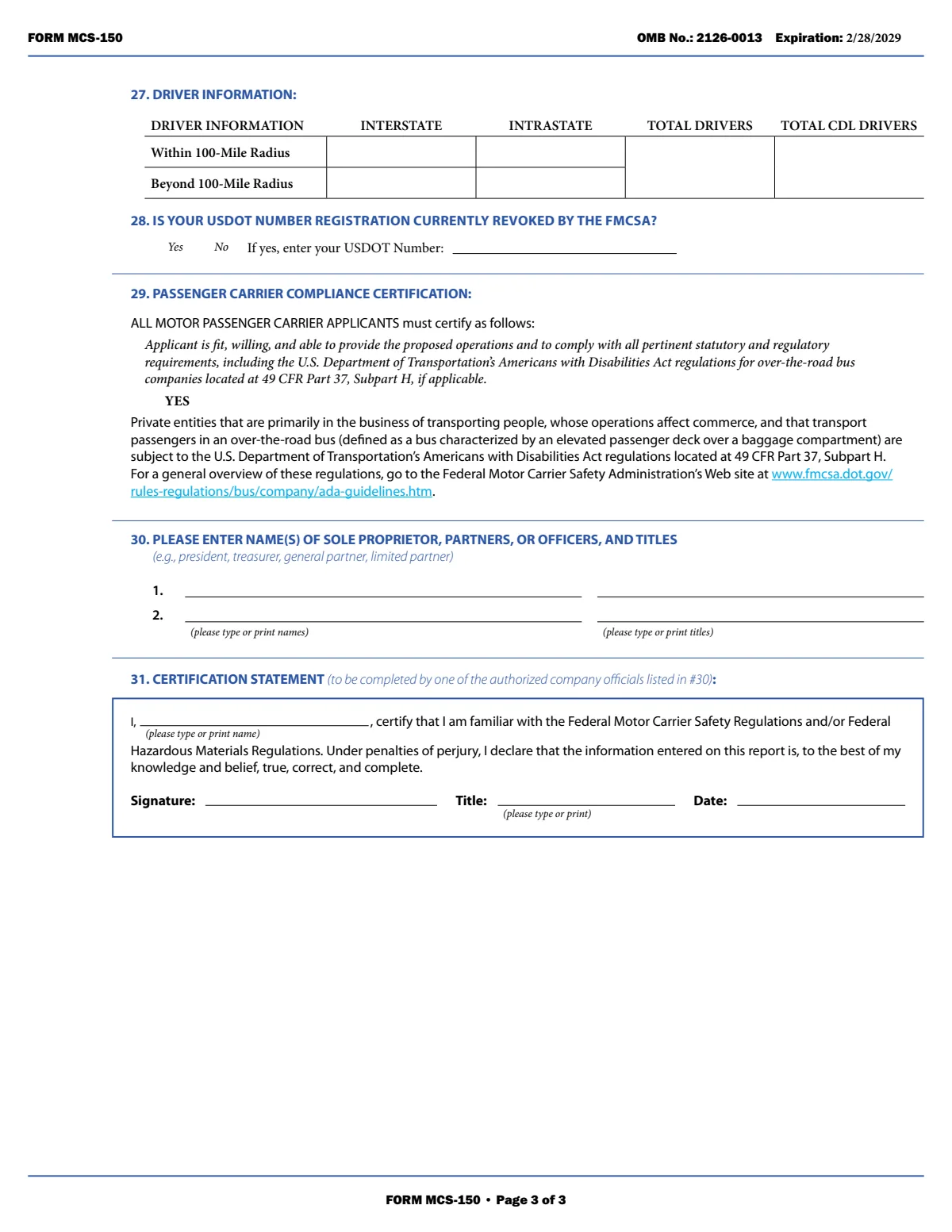
| 28 | Is your USDOT number registration currently revoked? | Answer Yes and give the number only if FMCSA has revoked it (for example a revoked new entrant registration); otherwise No. |
| 29 | Passenger carrier compliance certification | All passenger carrier applicants complete it. Check YES only if the statement is true. Over-the-road bus companies are also under the DOT's Americans with Disabilities Act rules at 49 CFR Part 37, Subpart H. |
| 30 | Names of sole proprietor, partners or officers, and titles | The owner of a sole proprietorship; otherwise two partners or two corporate officers, with titles (president, treasurer, general partner). |
| 31 | Certification statement | Print the signer's name, then sign, date and give a title. “The individual’s signature must match his/her name.” The signer should be one of the people in item 30. “Applications that are incomplete, unreadable, or unsigned will be rejected” and returned by mail. |
The biennial update schedule
The update month comes from the last digit of your USDOT number, and the year from the next-to-last digit. “If the next-to-last digit of its USDOT Number is odd, the motor carrier shall file its update in every odd-numbered calendar year.” An even next-to-last digit files in even-numbered years. File the update by the last day of the month in the table (49 CFR 390.19(b)(2))49 CFR 390.19Code of Federal Regulations, eCFR, even if nothing changed.
| USDOT number ends in | File by the last day of |
|---|---|
| 1 | January |
| 2 | February |
| 3 | March |
| 4 | April |
| 5 | May |
| 6 | June |
| 7 | July |
| 8 | August |
| 9 | September |
| 0 | October |
Example: USDOT number 1234567. The last digit is 7, so the month is July; the next-to-last digit is 6, even, so the update is due by July 31 of every even-numbered year (2026, 2028).
Rules that trip people up
- Do not apply for a second USDOT number. A company that has ever had one reapplies, reactivates or updates; the instructions say not to submit the form to obtain a new number.
- A P.O. box can be the mailing address (items 8 to 12), never the principal place of business (items 3 to 7).
- Item 21 is total miles for all your commercial vehicles, everywhere, rounded to the nearest 10,000, not only interstate or IFTA miles.
- Selecting Authorized For-Hire in item 23 also means filing for operating authority; the MCS-150 alone does not give you an MC number.
- The signer in item 31 must be one of the people in item 30, and the signature must match the printed name.
How it connects
- The update schedule and what happens if you miss it: MCS-150 biennial update.
- Who needs a USDOT number at all, and the weight lines: USDOT number and which filings apply by weight.
- For-hire carriers: MC number and operating authority, then UCR and IRP.
- All your filings in one list: the which filings do I need tool and the deadline calendar.
Questions filers ask
Do I have to file an MCS-150 update if nothing changed?
Yes. The rule requires an update every 24 months on the schedule set by your USDOT number, whether or not your details changed. Missing it can deactivate the number.
Which items do I fill in for a biennial update?
The instructions list items 1 to 16, 21, 30 and 31, plus any other item whose answer changed since your last filing.
Can I use my Social Security number in item 19?
A sole proprietor owner-operator without an EIN may, but FMCSA encourages an EIN, and you will need one for Form 2290 anyway.
How do I find my update month?
Use the last digit of your USDOT number for the month (1 is January, 0 is October) and the next-to-last digit for the year: odd digits file in odd years, even digits in even years.
How long does a paper MCS-150 take?
The instructions say mailed applications take four to six weeks on average. Online filing is faster, and incomplete or unsigned paper forms are sent back.