- Who files
- Carriers with vehicles in the Oregon weight-mile tax program
- Due (monthly)
- Last day of the next month (postmark)
- Due (quarterly)
- May 31, Aug 31, Nov 30, Feb 28
- Filed with
- ODOT Commerce and Compliance Division
- Late charge
- 10 percent of Box 4
At a glance
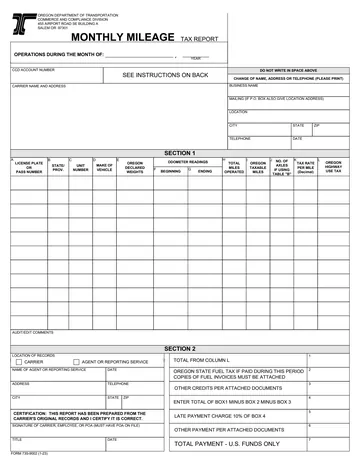
Form 735-9002 (1-23), the Monthly Mileage Tax Report, is how a carrier pays Oregon's weight-mile tax (the form calls it highway use tax) on trucks over 26,000 pounds: one line per power unit, miles on Oregon roads times the rate for its declared weight. This page follows the form and the instructions on its back. It is general information, not tax advice.
- File every period. ODOT requires a report for every period while you have ODOT plates or vehicles enrolled in the weight-mile tax program. “If there is no tax due, you must still file a report.”
- Monthly or quarterly. Monthly is the default; a carrier can apply on form 9030 to file quarterly on form 735-9002t.
- Online or mail. Oregon Trucking Online files and pays reports; on paper, “Reports are not considered filed until we receive your complete report and payment.”
- Not on this report. “DO NOT PAY ROAD USE ASSESSMENT FEES OR INVOICES FROM THE OVER-DIMENSIONAL PERMIT UNIT ON THIS REPORT.”
Tap a box once for its note, again to jump to the line. Zoom in to read the small print.
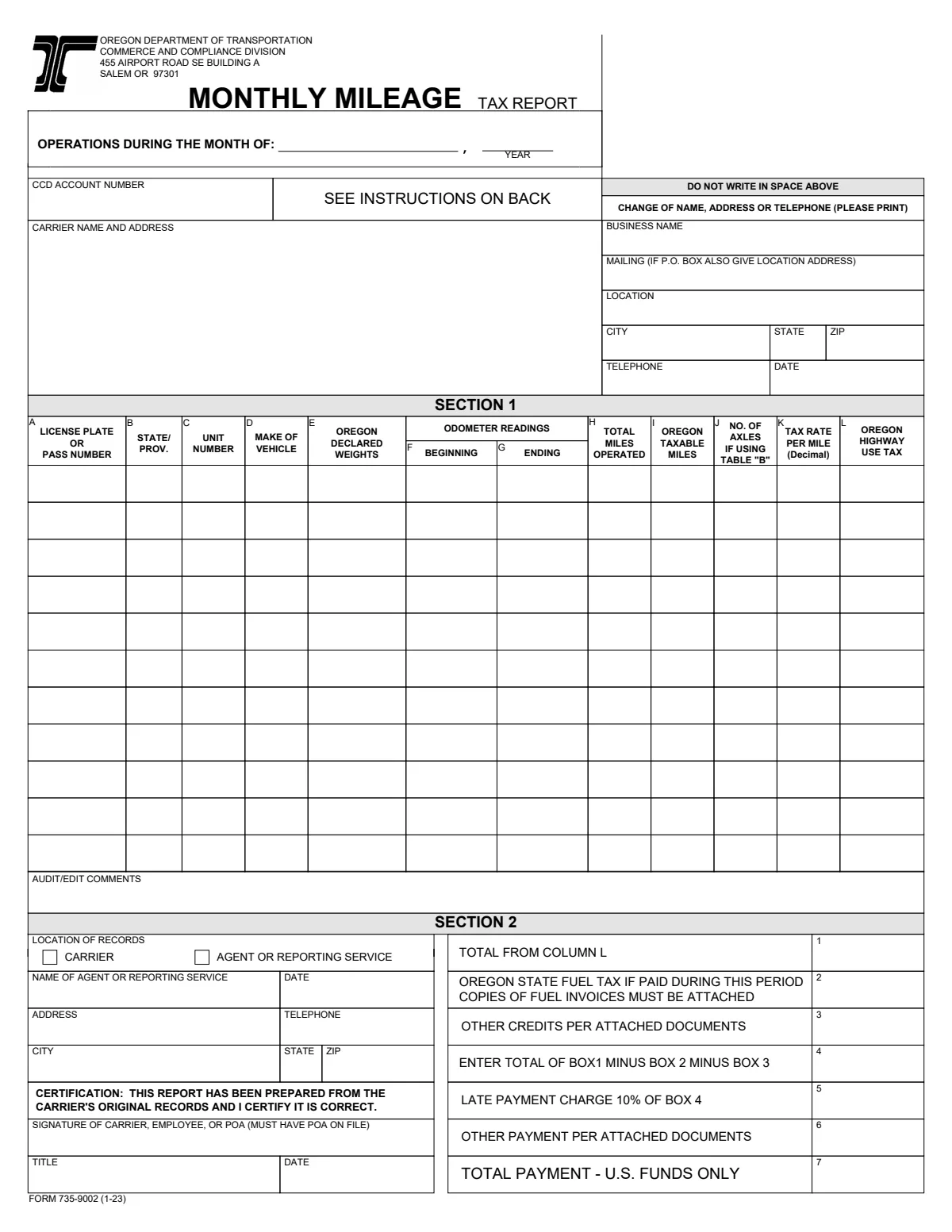
Top of the report
| Box | Label | What goes there |
|---|---|---|
| Month | Operations during the month of; year | The calendar month you are reporting. “Your report and payment must be postmarked by the Postal Service by the last day of the month following the end of the calendar month.” Quarterly filers use form 735-9002t instead (below). |
| Account | CCD account number | Enter the account number, as the instructions direct. |
| Carrier | Carrier name and address | The name and address of the business as filed with ODOT's Commerce and Compliance Division (CCD). |
| Changes | Change of name, address or telephone | Print a new business name, mailing address (with the location address if you use a P.O. box), city, state, ZIP, telephone and the date. |
Section 1: one line per vehicle
| Column | Label | What goes there |
|---|---|---|
| A | A. License plate or pass number | Enter the plate or pass number of the power unit for which you are reporting. One line per power unit. |
| B | B. State/Prov. | The state or province that issued the plate. |
| C | C. Unit number | Your company's unit number for the power unit. |
| D | D. Make of vehicle | The make. |
| E | E. Oregon declared weights | “You must declare and report operations at the heaviest weight operated per configuration.” It should be one of the weights you declared with ODOT. “If returning empty, use the same declared weight and tax rate as when loaded.” |
| F | F. Odometer readings: beginning | The reading from the first day of the month. “This should be the same as the ending odometer reading from the preceding month.” |
| G | G. Odometer readings: ending | The reading from the last day of the month. |
| H | H. Total miles operated | “Enter the total miles operated for each vehicle (Column G minus Column F).” Everywhere, not only in Oregon. |
| I | I. Oregon taxable miles | “Enter the Oregon taxable miles (miles operated on Oregon public roads).” “If you did not operate a vehicle, put a zero (0) in columns I and L.” |
| J | J. No. of axles if using Table "B" | “Enter the number of axles for any declared weight greater than 80,000 pounds.” |
| K | K. Tax rate per mile (decimal) | The rate from form 735-9928, Mileage Tax Rates. “If you are operating between 26,001 and 80,000 pounds, use” Table A rates; between 80,001 and 105,500 pounds under an extended weight permit, Table B, which also needs the axle count. “Raising a lift axle is not a change in configuration and does not constitute” a change in rate. The current tables are on the Oregon weight-mile tax page. |
| L | L. Oregon highway use tax | “Compute and enter the Oregon Highway Use Tax (Column I times Column K).” |
How a line adds up: odometer readings of 412,300 and 421,300 give 9,000 total miles in Column H; if 2,500 of them were on Oregon roads, Column I is 2,500, and Column L is 2,500 times the Table A rate for the declared weight in Column E. The rate comes from form 735-9928 for the period.
Section 2: payment and signature
| Box | Label | What goes there |
|---|---|---|
| Box1 | Box 1: Total from Column L | The total fees from Column L. |
| Box2 | Box 2: Oregon state fuel tax if paid during this period | “You may claim a credit if you pay Oregon state fuel tax on fuel purchases.” “Fuel must have been purchased in the same report month credit is claimed.” Attach invoices showing the date, supplier, fuel type, gallons, ODOT plate or pass number and the Oregon tax paid. Bulk fuel counts only when pumped into a qualified vehicle in the period. |
| Box3 | Box 3: Other credits per attached documents | Credits shown on your monthly Statement of Account, with a copy attached. “Do not use credits that have not yet appeared on” the Statement of Account. |
| Box4 | Box 4: Box 1 minus Box 2 minus Box 3 | The tax after credits. |
| Box5 | Box 5: Late payment charge 10% of Box 4 | Only for a late report: 10 percent of Box 4. |
| Box6 | Box 6: Other payment per attached documents | Other payments you add, with their documents. “Payments received without supporting documentation may not be correctly applied to” your account. |
| Box7 | Box 7: Total payment, U.S. funds only | Box 4 plus Box 5 plus Box 6. Enclose the payment and mail the original to ODOT Commerce and Compliance Division, 455 Airport Road SE, Building A, Salem, Oregon 97301. |
| Records | Location of records; agent or reporting service; name, address, phone | Mark whether the carrier or an agent keeps the records, and give the agent's details. |
| Certify | Certification, signature, title, date | The report is certified as prepared from the carrier's original records. “An authorized company representative or agent must sign the Report.” An agent needs a power of attorney on file with CCD. |
Quarterly filers: form 735-9002t
The Quarterly Mileage Tax Report, form 735-9002t (6-26), has the same columns and boxes for a whole quarter, and for fleets of 80,000 pounds and under it comes with the vehicles preprinted in Columns A to E and K. Its due dates are set by quarter: “Your report and payment must be postmarked by the Postal Service by:”
| Quarter | Period covered | Due |
|---|---|---|
| 1st | January through March | May 31 |
| 2nd | April through June | August 31 |
| 3rd | July through September | November 30 |
| 4th | October through December | February 28 |
Oregon's filing page puts it as the last day of the second month after the quarter, and adds: “Tax returns must be filed even when there is no tax due, regardless of whether there were Oregon operations only or no operations for the reporting period.”
Weight-mile tax and IFTA
An Oregon-based interstate carrier usually files both: the weight-mile report for Oregon road use and the IFTA return, form 735-9740, for fuel used in other jurisdictions. The two meet in three places: Oregon miles and fuel go on the IFTA return's Oregon line; an IFTA credit can be transferred to the weight-mile account; and Oregon fuel tax actually paid on fuel for a weight-mile vehicle comes back in Box 2.
Rules that trip people up
- Column E is the heaviest weight operated in that configuration, and returning empty keeps the loaded weight and rate.
- Column F must match last month's ending odometer reading.
- Box 2 credit needs the fuel invoices attached and fuel bought in the same month.
- File a zero report for a month with no operation: 0 in Columns I and L.
- Road use assessment fees and over-dimensional permit invoices are paid elsewhere, never on this report.
How it connects
- Who owes the tax, the rate tables and bonds: the Oregon weight-mile tax guide.
- Other states' weight-distance taxes: compared, the New York MT-903 form page and the weight-distance tax checker.
- Oregon's IFTA side: the form 735-9740 page and the Oregon IFTA guide.
Questions filers ask
When is the Oregon monthly mileage tax report due?
Postmarked by the last day of the month after the month reported. A late report adds 10 percent of Box 4 in Box 5.
Do I file if my truck did not run in Oregon this month?
Yes. Put 0 in Columns I and L and file; ODOT requires a report even when no tax is due.
Which rate table do I use?
Table A for declared weights of 26,001 to 80,000 pounds; Table B for 80,001 to 105,500 pounds under an extended weight permit, with the axle count in Column J. Both are on form 735-9928.
Can I get back Oregon fuel tax I paid at the pump?
Yes, as a credit in Box 2 for fuel bought in the same month, with copies of the invoices showing the Oregon tax paid.
Can I file quarterly instead of monthly?
Yes, if ODOT approves form 9030. Quarterly reports go on form 735-9002t, due the last day of the second month after the quarter.